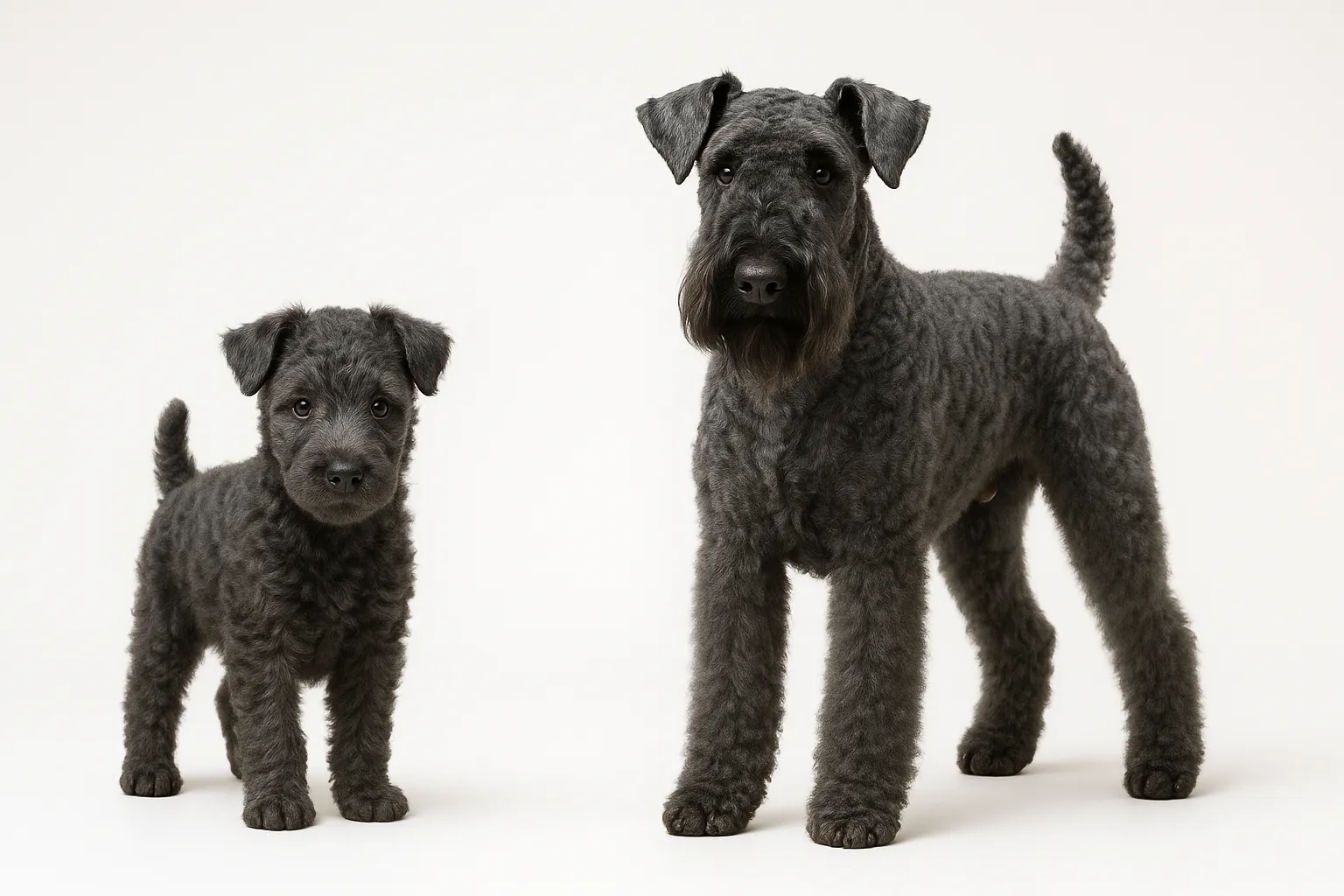
The Kerry Blue Terrier Lifespan: What the Data Shows
Ireland’s national dog is a paradox — a curly blue-coated terrier that hunted, herded, and guarded farms with equal conviction, yet carries a neurological disease burden that demands careful genetic stewardship. At 33-40 lbs, Kerry Blue Terriers are larger than most terriers and live 12-15 years, reflecting their functional working heritage.
That lifespan is achievable, but not guaranteed. Progressive retinal atrophy, cerebellar abiotrophy (a breed-specific fatal neurological disease), and degenerative myelopathy all appear at elevated rates. DNA testing before breeding — and before purchasing a puppy — is the single most important longevity decision for this breed.
Kerry Blues also face inherited eye conditions beyond PRA, and epilepsy occurs at documented rates. The neurological disease profile is notable enough that genetic testing should be treated as a prerequisite, not an optional add-on.
What This Breed Is Most Likely to Face
Progressive Retinal Atrophy
Progressive retinal atrophy (prcd-PRA) affects Kerry Blue Terriers at documented rates. DNA testing identifies clear, carrier, and affected dogs before symptoms appear. PRA causes progressive bilateral vision loss, beginning with night blindness and advancing to complete blindness.
Annual CAER exams provide clinical surveillance even for DNA-tested dogs, since other eye conditions can develop independently. Responsible breeders test all breeding stock and avoid carrier-to-carrier pairings.
See the Progressive Retinal Atrophy guide for full prevention and management detail.
Cerebellar Abiotrophy
Cerebellar abiotrophy — a progressive degeneration of Purkinje cells in the cerebellum — is documented in Kerry Blue Terriers and is unique to the breed in its specific presentation. Affected puppies show progressive cerebellar signs (ataxia, head tremor, hypermetria) beginning at 2-6 months of age. The condition is fatal and progressive.
DNA testing, when available for the Kerry Blue-specific mutation, enables breeders to avoid producing affected litters. The Kerry Blue Terrier Club of America tracks neurological health data.
See the Cerebellar Abiotrophy guide for full prevention and management detail.
Epilepsy
Epilepsy is documented in Kerry Blue Terriers. Dogs with two or more unprovoked seizures require full neurological evaluation — particularly important in this breed, where seizures must be differentiated from other documented neurological conditions. Anticonvulsant therapy with drug level monitoring every 6 months manages idiopathic epilepsy effectively.
See the Epilepsy guide for full prevention and management detail.
What the Evidence Says About Living Longer
Neurological Disease DNA Testing
Kerry Blues carry a higher-than-average neurological disease burden, and this is where informed puppy selection pays the largest dividends. Before purchasing a Kerry Blue puppy, request DNA testing documentation for prcd-PRA and degenerative myelopathy from both parents. Ask specifically about cerebellar abiotrophy screening in the breeder’s lines.
DNA testing panels from OFA/CHIC, Embark, or breed-specific labs provide actionable results. Responsible breeders working actively with breed health programs can provide multi-generation health data — that depth of information is the most powerful longevity investment available at the time of puppy selection.
The Blue Coat Color Progression
Kerry Blue Terrier puppies are born black. The distinctive blue-gray coat develops gradually through puppyhood and is not complete until approximately 18 months — a process called “going blue.” This is normal and expected.
Adult Kerry Blues range from deep slate to light blue-gray. The wavy, soft coat requires professional trimming every 6-8 weeks and regular brushing between appointments. Unlike many terriers, the Kerry Blue coat does not need stripping. Scissoring is the standard grooming technique.
Versatile Irish Working Dog
Kerry Blues were used in Ireland for a remarkable range of tasks: hunting rabbit, otter, and badger; herding cattle and sheep; retrieving waterfowl; and controlling farm vermin. That versatility reflects high intelligence and trainability that persists in the modern breed.
Today’s Kerry Blues excel in obedience, agility, nose work, and herding trials. Their high drive requires consistent daily exercise and mental engagement. Without adequate work, they channel that intelligence into creative destruction.
Priority Actions for a Longer Life
The actions most likely to extend your Kerry Blue Terrier’s healthy years:
- DNA testing for progressive retinal atrophy (prcd-PRA) — documented in Kerry Blues
- Annual CAER eye exam from age 1 — multiple inherited eye conditions documented in the breed
- DNA testing for degenerative myelopathy — elevated DM risk documented in Kerry Blues
These are your highest-return prevention targets. Build your next vet conversation around them and adjust quarterly as data accumulates. See Progressive Retinal Atrophy Pra, Eye Conditions, Seizures Epilepsy for detailed guidance.
Evidence-Based Longevity Priorities
Body Composition and Muscle Maintenance
Maintaining stable weight and lean muscle mass in Kerry Blue Terriers is one of the highest-yield longevity interventions available. Body composition stability directly predicts orthopedic longevity and cardiovascular reserve in this medium breed. These high-energy terriers burn calories fast, so calorie management must be precise to avoid gradual drift.
Condition-Focused Prevention Stack
Build your prevention strategy around Progressive Retinal Atrophy Pra, Eye Conditions, Seizures Epilepsy. These are the conditions where early detection and sustained intervention most reliably extend healthy years.
Behavior, Stress Load, and Recovery
Inconsistent schedules and uncontrolled arousal in Kerry Blues often surface first as behavior volatility, sleep fragmentation, or slower recovery from exertion. A controlled daily rhythm protects both neurologic and physical stability — important in a breed with elevated neurological disease risk.
Preventive Screening Cadence
Schedule veterinary reassessment intervals by age band and trend changes rather than waiting for obvious deterioration. Planned checkpoints focused on neurologic function, vision, and gait quality improve early detection and intervention timing.
Breed-Specific Research
Use these evidence deep dives to add mechanism-level context to your Kerry Blue Terrier longevity plan:
- Genetic Testing For Dogs Clinical Roi: PRA genetic testing and neurological disease screening in Kerry Blue Terriers
- Exercise Prescription By Life Stage: exercise management for an active medium working terrier across life stages
- Senior Dog Screening Protocol: monitoring framework for a 12-15 year medium terrier
Using DNA Data to Guide Prevention
Genetic testing in Kerry Blue Terriers delivers the most value when results directly change what gets measured, how often, and what triggers escalation. Consider hip and elbow scoring (OFA or PennHIP) to quantify orthopedic risk, and breed-specific cancer panels or tumor marker surveillance when available.
- Start with a genetic panel designed around your Kerry Blue Terrier’s most common conditions. Let the results prioritize which health areas deserve closer surveillance.
- Anchor your initial monitoring to Progressive Retinal Atrophy Pra and Eye Conditions. Testing matters when it changes what you measure, how often, and what triggers escalation.
- Your most powerful monitoring tool costs nothing — a running record linking test data to clinical findings to what you observe at home. The connections between entries are where the real insights live.
- The right monitoring cadence at two years old is wrong at nine. Recalibrate at every life-stage transition and whenever you see sustained drift in energy, appetite, or mobility.
Testing is only as good as the decisions it drives. If nothing changes after you get the results, the test was premature or unnecessary.
Breeding History & Health Implications
The Kerry Blue Terrier was bred for high-intensity prey drive, tenacity, and versatile farm work across Ireland’s Kerry mountains. That heritage produced a remarkably capable dog — but also one with structural load patterns and cancer susceptibility that benefit from proactive surveillance throughout adulthood.
- Elevated neurological disease burden and cancer susceptibility require tighter monitoring cadence than many medium terrier owners expect.
- Focus your risk surveillance on Progressive Retinal Atrophy Pra, Eye Conditions, Seizures Epilepsy — these are the conditions where this breed’s ancestry creates the most actionable risk profile.
- Never assume gradual changes in your Kerry Blue Terrier are just “aging.” A half-step of lost speed, slightly reduced appetite, or longer post-exercise recovery are patterns that warrant veterinary attention, not acceptance.
- As your Kerry Blue Terrier ages and health data accumulates, the plan should change with it. Schedule a quarterly review to recalibrate priorities based on what you are actually seeing.
The breed’s DNA writes the risk profile. Your dog’s longitudinal health data writes the intervention plan.
The Screening Calendar That Matters
- Puppy: prcd-PRA DNA testing, DM DNA testing, cerebellar abiotrophy awareness
- 1-2 years: CAER exam, OFA hip evaluation, neurological observation
- 3-8 years: annual CAER exam, wellness bloodwork, agility health monitoring
- 9+ years: biannual senior panel, dental care, mobility assessment
Fuel for the Long Run
Kerry Blue Terriers do well on quality medium-breed adult food. Their high activity level requires caloric intake calibrated to actual exercise, not estimated needs. Lean body condition supports joint health and long-term mobility. Omega-3 supplementation supports coat quality and joint health. Regular dental care complements a breed-appropriate nutrition plan.
Your Long-Term Health Trajectory
Kerry Blue Terriers with comprehensive DNA testing, annual CAER surveillance, and appropriate working dog enrichment can achieve their full longevity potential of 13-15 years. Proactive neurological disease screening — ideally before you even bring a puppy home — is the most important longevity investment for this breed. The dogs that reach 15 are typically the ones whose owners started prevention at selection.
Most-Missed Early Drift Pattern
Healthspan erosion in Kerry Blue Terriers typically begins with subtle shifts that are easy to miss:
- Night blindness or hesitation navigating dim spaces tied to Progressive Retinal Atrophy Pra that gets attributed to unfamiliarity rather than vision loss
- Subtle hesitation in dim light or unfamiliar spaces masking Eye Conditions progression
- Brief, intermittent episodes tied to Seizures Epilepsy that seem too minor to report
A week of consistent deviation from your dog’s normal baseline is not a fluctuation. It is a signal that warrants veterinary reassessment.
Additional Health Risks to Monitor
Based on breed predisposition data, Kerry Blue Terrier owners should also be aware of:
Frequently Asked Questions
How long do Kerry Blue Terriers live?
Kerry Blue Terriers typically live 12-15 years. Neurological disease DNA testing (PRA, DM) and annual CAER eye surveillance are the primary longevity investments.
Why are Kerry Blue Terriers blue?
Kerry Blues are born black and gradually develop their distinctive blue-gray coat through a process called “going blue” that completes around 18 months. The blue color results from a dilution gene affecting black pigmentation, producing the characteristic slate-gray coat.
Are Kerry Blue Terriers hypoallergenic?
Kerry Blue Terriers are often described as low-shedding and sometimes recommended for allergy sufferers. Their wavy, soft coat sheds minimally, but no dog breed is truly hypoallergenic.
Are Kerry Blue Terriers good family dogs?
Kerry Blues are loyal, energetic, and affectionate with their family. They can be assertive with other dogs — early socialization is essential. Their intelligence and versatility make them excellent working companions for active families.
What is cerebellar abiotrophy in Kerry Blue Terriers?
Cerebellar abiotrophy is a progressive fatal degeneration of Purkinje cells in the cerebellum causing loss of coordination, ataxia, and tremor beginning in puppyhood. The condition is not treatable. DNA testing when available allows breeders to avoid producing affected litters.
References
[1] Kerry Blue Terrier Club of America. uskbtc.com. [2] Prcd-PRA in terrier breeds: OFA CAER database. [3] Cerebellar abiotrophy in Kerry Blues: various veterinary neurology reports. [4] AKC breed information. akc.org. [5] Irish breed history: Irish Kennel Club records.
Related Reading
Continue exploring