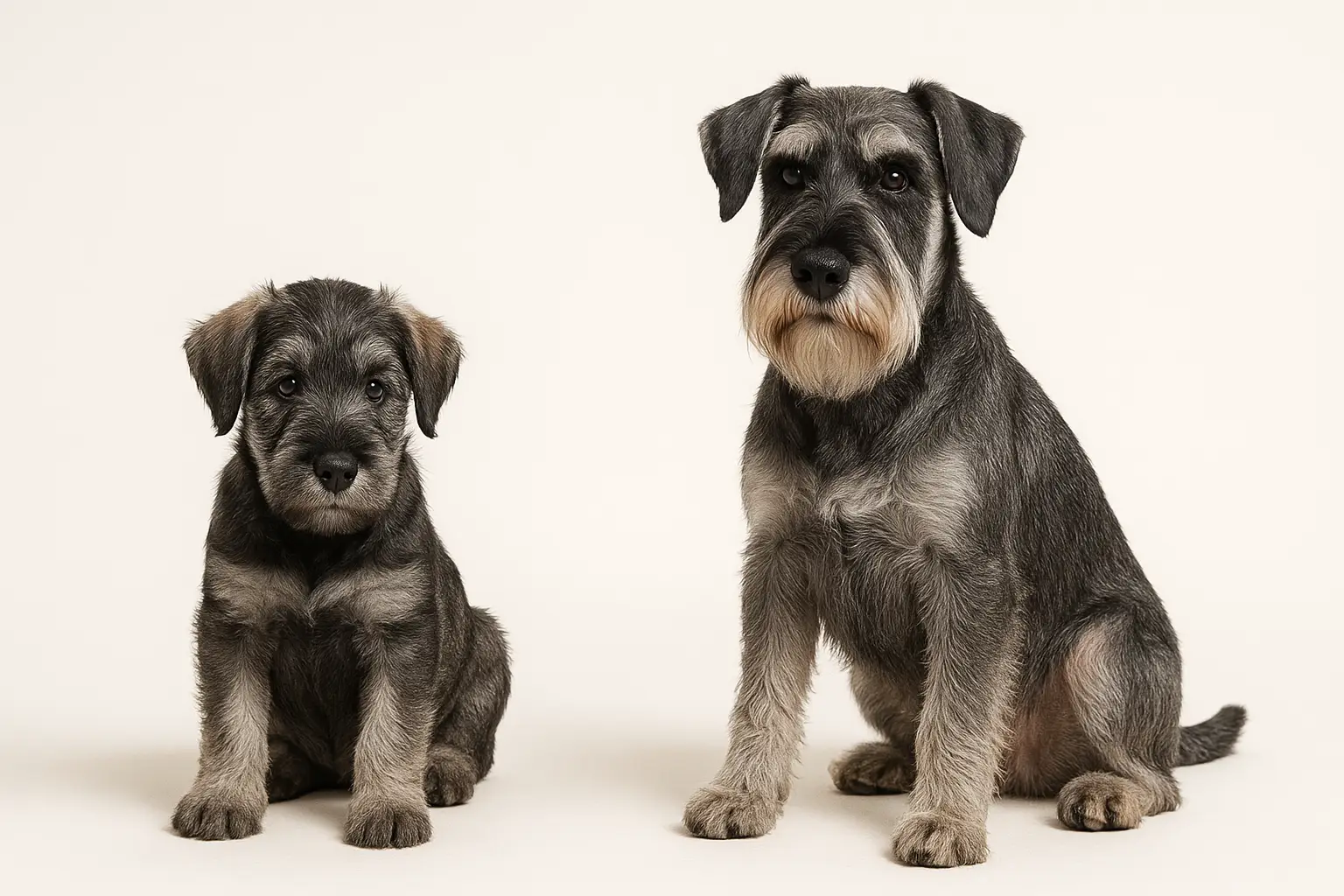
The Original Schnauzer — and One of the Longest-Lived Working Breeds
The Standard Schnauzer is the original — the ancestral breed from which breeders developed both the Miniature and the Giant Schnauzer. Medium-sized and distinctively bearded, these dogs are energetic, sharp-minded, and remarkably long-lived for a working breed. Many Standard Schnauzers reach 14-16 years, a span that reflects centuries of functional selection without extreme physical exaggeration.
Their health burden is low relative to most breeds of comparable size. Hip dysplasia is the primary structural concern, and hereditary cataracts are documented. Follicular cysts and skin conditions can develop under an improperly maintained coat. But overall, the Standard Schnauzer’s 13-16 year lifespan speaks to a breed that was built to work, not to look a certain way.
The Health Landscape for This Breed
Hip Dysplasia
Hip dysplasia is the primary orthopedic concern in Standard Schnauzers. OFA hip evaluation at 24 months establishes a structural baseline. Because these dogs are active and energetic, hip integrity directly affects quality of life throughout adulthood. Lean body condition from puppyhood onward remains the most effective modifiable intervention.
See the Hip Dysplasia guide for full prevention and management detail.
Eye Conditions
Hereditary cataracts are documented in the breed. Annual CAER exams starting at age 1 provide ongoing surveillance, and progressive cataracts affecting vision may eventually require surgical consultation. The Standard Schnauzer Club of America tracks eye health data and recommends annual CAER registration for all breeding dogs.
See the Eye Conditions guide for full prevention and management detail.
Skin Conditions
Standard Schnauzers can develop skin conditions under their wiry coat when grooming is inadequate. Follicular cysts and comedones — sometimes called “schnauzer bumps” or schnauzer comedo syndrome — produce multiple small papules along the dorsal midline. Treatment includes benzoyl peroxide shampoos and, in severe cases, topical retinoids.
See the Skin Conditions guide for full prevention and management detail.
Evidence-Based Ways to Extend Healthspan
Exceptional Longevity in a Working Breed
A Standard Schnauzer living to 14-16 is not unusual. That longevity means senior care protocols should begin at age 10: biannual wellness visits, annual dental cleaning, cardiac monitoring, and cognitive function tracking.
Dogs living into their mid-teens may develop age-related hearing loss, lens changes (nuclear sclerosis vs. cataracts), and cognitive shifts. All of these are manageable with appropriate environmental adaptation. The key insight: long-lived dogs benefit proportionally from every health investment made throughout adulthood.
Beard Maintenance and Skin Health
The Standard Schnauzer’s iconic beard traps food debris and moisture after every meal and water break, creating conditions for bacterial overgrowth and skin fold infection at the lip commissures. Daily cleaning with a damp cloth or dog-safe wipes after meals prevents buildup.
Monthly professional grooming maintains the distinctive Schnauzer trim. Hand-stripping — not clipping — preserves the wiry coat texture and skin health. Over-clipped coats develop soft texture and more skin fold issues.
Intelligent Working Dog Engagement
These dogs are genuinely intelligent and need significant daily mental engagement. They were developed as versatile farm dogs — catching vermin, guarding property, herding — and their working drive persists.
Standard Schnauzers excel in obedience, tracking, agility, and protection sports. Without adequate mental challenge, they become bored and creative in ways you will not enjoy. They are one of the more demanding medium breeds for owners who prefer a lower-engagement companion.
Where to Focus Your Prevention Effort
These are the investments that pay the highest longevity dividend for a Standard Schnauzer:
- OFA hip evaluation at 24 months — hip dysplasia is the primary orthopedic concern
- Annual CAER eye exam — hereditary cataracts documented in Standard Schnauzers
- Beard and skin fold cleaning — the facial beard traps debris and requires daily maintenance
Make these the backbone of your Standard Schnauzer’s preventive care calendar. Each quarter, assess whether you are on track or need to escalate. Detailed protocols live in Hip Dysplasia, Eye Conditions, Skin Allergies .
Evidence-Based Longevity Priorities
Body Composition and Muscle Maintenance
Weight stability and muscle quality are foundational to orthopedic and metabolic health in this breed. Body composition directly predicts joint longevity and cardiovascular reserve. Their history of guarding and weight-pulling work means that muscle maintenance directly supports functional longevity throughout their long lifespan.
Condition-Focused Prevention Stack
The highest-return prevention targets are Hip Dysplasia, Eye Conditions, and Skin Allergies. The cost of early action is almost always lower than the cost of delay — in treatment complexity, in quality of life, and in total lifespan.
Behavior, Stress Load, and Recovery
Household rhythm quality directly affects healthspan in Standard Schnauzers. Inconsistent schedules and unclear role structure often manifest as behavior drift, vigilance patterns, or recovery problems before any physical decline becomes visible.
Preventive Screening Cadence
Set routine veterinary checkpoints and escalate frequency when orthopedic function or gait quality shows early drift. Prevention windows close fast once symptoms become obvious.
Breed-Specific Research
Use these evidence deep dives to add mechanism-level context to your Standard Schnauzer longevity plan:
- Senior Dog Screening Protocol: extended senior monitoring framework for a breed that commonly lives 14-16 years
- Dental Disease And Longevity In Dogs: dental care across a very long lifespan in a medium working breed
- Canine Cognitive Decline Early Action Plan: cognitive health monitoring for a long-lived highly intelligent working breed
Genetic Testing: When It Matters
Genetic testing delivers the most value when results directly change what gets measured, how often, and what triggers escalation. Consider hip and elbow scoring (OFA or PennHIP) to quantify orthopedic risk and CERF eye exam or PRA gene testing to detect heritable eye disease.
- A well-chosen initial panel gives you a risk map. Follow-up assessments at regular intervals tell you which risks are materializing and which remain theoretical.
- Your first monitoring protocols should target Hip Dysplasia and Eye Conditions. The goal is results that change behavior — not just data that sits in a file.
- Document weight, energy level, appetite patterns, and any changes you notice between vet visits. When combined with clinical data, home observations often reveal the earliest signs of drift.
- Return to your test results whenever something changes — a new lameness, unexplained weight loss, or behavioral shift. Static data becomes useful again when the clinical context moves.
The point of testing is not the result — it is what you do differently because of it.
Breeding History & Health Implications
The Standard Schnauzer was bred for guarding, draft work, and farm versatility. That legacy shaped a dog with structural demands that benefit from proactive orthopedic surveillance throughout adulthood.
- Let the breed’s history guide your watch list. The conditions most worth proactive monitoring are Hip Dysplasia, Eye Conditions, Skin Allergies.
- When you see the same subtle finding twice — a slight limp, a missed meal, a slower recovery — treat it as a signal, not a coincidence. Tighten your monitoring before it compounds.
- Anchor your prevention plan to the latest data, not the original risk assessment. What your Standard Schnauzer needed at two years old and what they need at eight are different conversations.
Breeding history narrows the search. Serial monitoring data makes the call.
Monitoring Schedule by Life Stage
- Puppy to 2 years: OFA hip evaluation, CAER exam, beard care protocol established
- 3-8 years: annual CAER exam, wellness bloodwork every 2 years, beard and coat maintenance
- 9+ years: senior panel biannually, cardiac monitoring, dental care, cognitive function tracking
Fuel for the Long Run
Standard Schnauzers do well on quality medium-breed adult food. Their active nature means caloric intake should be calibrated to actual activity level. Lean body condition protects joint health and preserves the breed’s exceptional longevity potential. Omega-3 supplementation supports coat, skin, and joint health.
Putting It All Together
Standard Schnauzers are longevity outliers among working breeds. Their functional breeding heritage and moderate size support exceptional lifespans of 14-16 years with appropriate care. OFA screening, annual CAER exams, and consistent dental care are the investments that protect their longevity potential most effectively.
Most-Missed Early Drift Pattern
Healthspan erosion in Standard Schnauzers typically begins with subtle shifts that owners normalize:
- Hind-limb stiffness after rest related to Hip Dysplasia that looks like “just getting going in the morning”
- Subtle hesitation in dim light or unfamiliar spaces hinting at Eye Conditions progression
- Chronic hot spots, secondary infections, or coat degradation signaling Skin Allergies that have been building
Seven to ten days of sustained change in appetite, mobility, energy, or behavior is the threshold for escalating to your vet rather than continuing to observe.
Additional Health Risks to Monitor
Based on breed predisposition data, Standard Schnauzer owners should also be aware of:
Frequently Asked Questions
How long do Standard Schnauzers live?
Standard Schnauzers typically live 13-16 years, which is exceptional for a medium working breed. OFA orthopedic screening, CAER eye monitoring, and consistent dental care are the primary longevity investments.
What is the difference between Standard, Miniature, and Giant Schnauzers?
The Standard Schnauzer is the original breed, from which the Miniature and Giant were developed. The Miniature (11-20 lbs) was developed by adding small breeds; the Giant (55-80 lbs) by adding larger working breeds. All three are distinct AKC breeds with different health profiles and lifespans.
Are Standard Schnauzers hypoallergenic?
Standard Schnauzers have a wiry, low-shedding coat that is sometimes described as hypoallergenic. They shed less than many breeds, which may benefit some allergy sufferers. However, no dog breed is truly hypoallergenic.
Are Standard Schnauzers good family dogs?
Standard Schnauzers are loyal, versatile, and energetic family dogs for active owners. They require consistent training and mental engagement. Their intelligence makes them quick learners — and creative problem-solvers when bored. Early socialization shapes well-adjusted adult behavior.
Are Standard Schnauzers rare?
Standard Schnauzers are significantly less common than Miniature Schnauzers (one of the most popular small breeds) in North America, despite being the ancestral breed. They remain a relatively uncommon companion dog outside of working dog and show dog communities.
References
[1] Standard Schnauzer Club of America. standardschnauzer.org. [2] OFA health statistics. ofa.org. [3] Schnauzer comedo syndrome: Gross TL et al. Vet Dermatol. 2005. [4] AKC breed information. akc.org. [5] Dürer paintings of Schnauzer-type dogs: Kunsthistorisches Museum Wien documentation.
Related Reading
Continue exploring