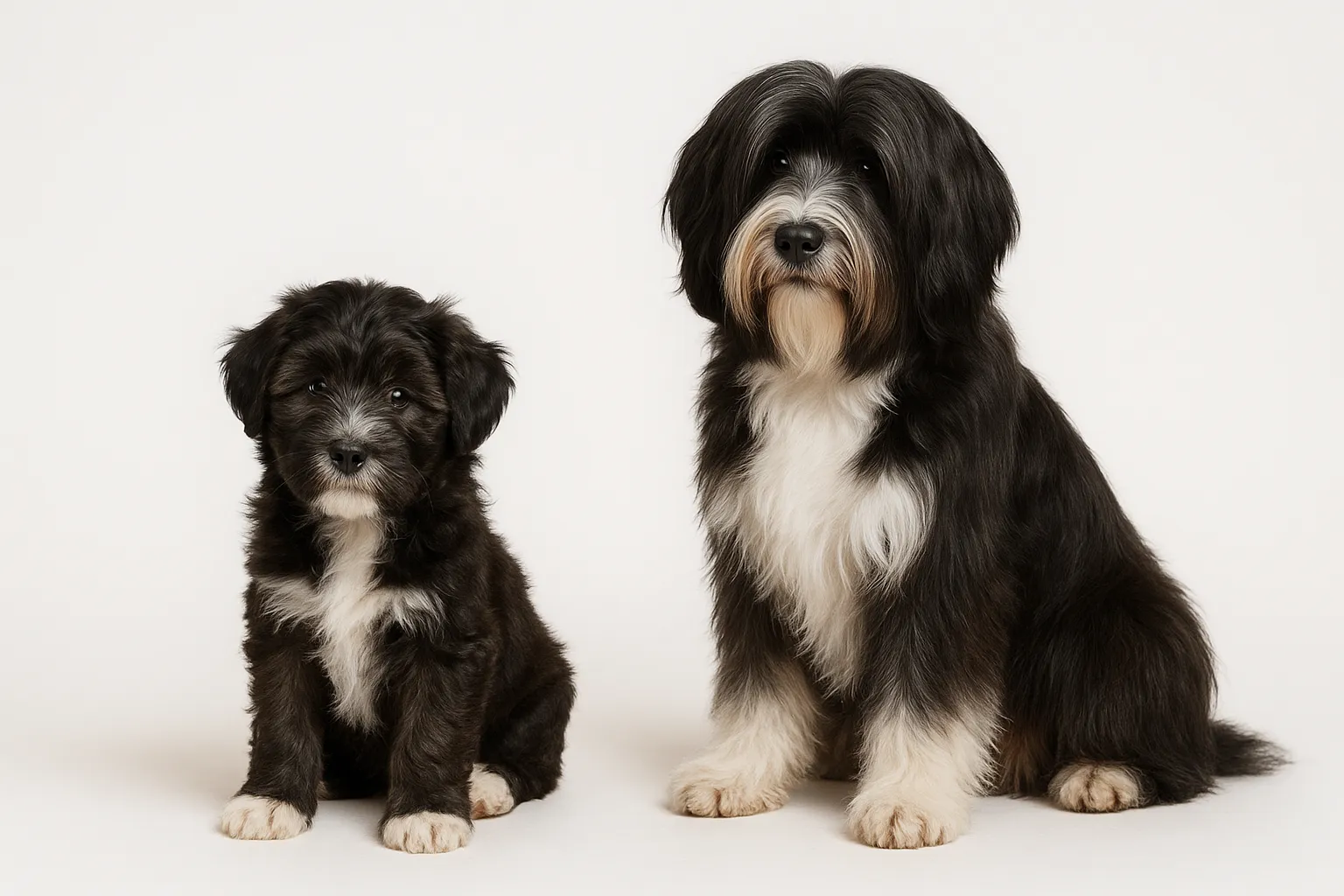
Not a Terrier at All — A Sacred Tibetan Companion With Two Genetic Threats
The name is a misnomer. Tibetan Terriers are not terriers at all — they have none of the digging, hunting instinct that defines the terrier group. They are Tibetan companion dogs, bred in Buddhist monasteries and considered sacred enough that they were never sold, only given as gifts.
Medium-sized and draped in a long, thick coat, they typically live 12-15 years. The breed carries two serious documented hereditary conditions: progressive retinal atrophy (PRA) and neuronal ceroid lipofuscinosis (NCL), a fatal lysosomal storage disease causing progressive neurological deterioration. Both are detectable through DNA testing. That makes genetic screening the single most important longevity decision for this breed.
What This Breed Is Most Likely to Face
Progressive Retinal Atrophy
PRA in Tibetan Terriers is heritable and causes progressive vision loss beginning with night blindness, advancing to complete blindness over time. DNA testing identifies affected and carrier status. Annual CAER examinations provide clinical monitoring. Affected dogs adapt well to blindness with consistent environmental management.
See the Progressive Retinal Atrophy guide for full prevention and management detail.
Hip Dysplasia
Hip dysplasia occurs at rates consistent with medium-sized breeds. OFA hip evaluation at 24 months establishes a structural baseline. Weight management and omega-3 supplementation support joint health. Significant dysplasia affecting mobility warrants pain management and orthopedic consultation.
See the Hip Dysplasia guide for full prevention and management detail.
Luxating Patella
Patellar luxation is documented across all grades. Grades I-II can often be monitored without intervention. Grades III-IV benefit from surgical correction to prevent progressive joint damage. Watch for gait changes or intermittent skipping — these warrant orthopedic evaluation.
See the Luxating Patella guide for full prevention and management detail.
Practical Longevity Strategies
NCL DNA Testing: The Non-Negotiable Screen
Neuronal ceroid lipofuscinosis (NCL) in Tibetan Terriers causes progressive neurological deterioration beginning in young adulthood. Affected dogs typically deteriorate rapidly and die by 3-5 years. There is no treatment.
DNA testing for Tibetan Terrier-specific NCL mutations is available. All breeding dogs should be tested, and puppies from carrier parents should be tested before placement. Prevention through testing is the only management strategy. This is one test that cannot be skipped.
Eye Health Monitoring
Annual CAER examinations provide clinical monitoring for PRA and other hereditary ocular conditions. DNA testing for PRA mutations specific to Tibetan Terriers allows early identification before clinical signs appear.
While PRA is not life-threatening, progressive blindness significantly affects quality of life. Environmental consistency and visual impairment training improve outcomes for affected dogs. Early diagnosis buys you preparation time that makes a real difference.
Coat and Skin Management
The long, thick double coat requires substantial grooming — weekly brushing at minimum, monthly full grooming sessions. But grooming is more than cosmetics. The coat can mask weight gain, skin disease, and body condition changes if care is neglected.
Monthly body condition scoring during grooming sessions provides ongoing health monitoring that would otherwise be invisible under all that hair.
Where to Focus Your Prevention Effort
Start here — these are the highest-impact moves for Tibetan Terrier longevity:
- PRA and NCL (ceroid lipofuscinosis) DNA testing — both hereditary blinding/neurological conditions are documented in Tibetan Terriers
- Annual CAER ophthalmology exam for early retinal disease detection
- OFA hip evaluation at 24 months — moderate hip dysplasia risk in this medium breed
Concentrate your prevention budget — time, money, and attention — on these conditions. They represent the highest-probability risks and the areas where early action matters most. See Progressive Retinal Atrophy Pra, Hip Dysplasia, Luxating Patella for the full breakdown.
Evidence-Based Longevity Priorities
Body Composition and Muscle Maintenance
Weight stability and muscle quality are foundational to orthopedic and metabolic health. Body composition directly predicts joint longevity and cardiovascular reserve. Consistent monitoring prevents the metabolic and orthopedic drift that the heavy coat makes difficult to spot visually.
Condition-Focused Prevention Stack
The highest-return prevention targets are Progressive Retinal Atrophy Pra, Hip Dysplasia, and Luxating Patella. The cost of early action is almost always lower than the cost of delay — in treatment complexity, in quality of life, and in total lifespan.
Behavior, Stress Load, and Recovery
Inconsistent schedules often manifest as behavior drift, sleep problems, or recovery challenges before any physical decline becomes visible. Tibetan Terriers are sensitive to household rhythm and benefit from predictable daily structure.
Preventive Screening Cadence
Set routine veterinary checkpoints and escalate frequency when orthopedic function or gait quality shows early drift. Prevention windows close fast once symptoms become obvious.
Breed-Specific Research
Use these evidence deep dives to add mechanism-level context to your Tibetan Terrier longevity plan:
- Genetic Testing For Dogs Clinical Roi: evidence for NCL and PRA DNA testing in hereditary disease prevention
- Home Biomarker Tracking For Senior Dogs: monitoring framework for senior Tibetan Terriers
- Canine Obesity And Lifespan Evidence: weight management evidence — coat can mask body condition drift
Genetic Testing: When It Matters
Genetic testing delivers the most value when results directly change what gets measured, how often, and what triggers escalation. Consider hip and elbow scoring (OFA or PennHIP) to quantify orthopedic risk and CERF eye exam or PRA gene testing to detect heritable eye disease.
- A well-chosen initial panel gives you a risk map. Follow-up assessments at regular intervals tell you which risks are materializing and which remain theoretical.
- Build your initial monitoring playbook around Hip Dysplasia and Progressive Retinal Atrophy Pra, so that every test result feeds into a specific follow-up action.
- Keep a unified record of all test results, vet findings, and home observations. The connections that matter most — slow trends, seasonal patterns — only show up when all the data lives in one place.
- Each time your Tibetan Terrier enters a new life stage or shows a persistent change in function, go back to the genetic data and ask what it means in the new context.
Every genetic or diagnostic result should answer one question: what do I do differently starting now?
Breeding History & Health Implications
The Tibetan Terrier was bred as a monastery companion and all-purpose dog in the harsh Tibetan plateau environment. That heritage shaped a sturdy, adaptable dog whose primary modern health risks are genetic rather than structural.
- Direct your monitoring attention first to Hip Dysplasia, Progressive Retinal Atrophy Pra, Luxating Patella — these are the risks that the breed’s working history and health data identify as most likely.
- Repeated low-grade signals are how most chronic conditions announce themselves. Respond to the pattern, not just the individual data point.
- Static prevention plans decay in value. The most effective owners treat their Tibetan Terrier’s health plan as something that evolves with every vet visit and every home observation.
Breeding history narrows the search. Serial monitoring data makes the call.
Preventive Care Timeline
- Puppy: NCL DNA test, PRA DNA test, baseline CAER exam, patellar evaluation
- 3-7 years: annual CAER, annual wellness panel, OFA hip at 24 months, body condition during grooming
- 8+ years: senior panel, neurological monitoring for late-onset conditions
Feeding for Longevity
Tibetan Terriers thrive on complete medium-breed adult diets. The thick coat benefits from adequate essential fatty acid nutrition, and omega-3 supplementation supports coat, skin, and joint health. Weight management deserves particular attention since the coat can mask body condition drift. Maintain BCS 4-5/9.
What a Well-Managed Life Looks Like
Tibetan Terriers with known NCL and PRA status — cleared through responsible testing or carrier-without-carrier-mate pairings — are long-lived companion dogs that often reach the upper end of the 12-15 year range. The breed’s primary longevity risks are almost entirely genetic and preventable. Testing before breeding is the lever that moves the needle most.
Most-Missed Early Drift Pattern
Healthspan erosion in Tibetan Terriers typically begins with subtle shifts that owners normalize:
- Hind-limb stiffness after rest related to Hip Dysplasia that looks like the dog just needs to “warm up”
- Hesitation at dusk, bumping into objects in new spaces, or reluctance to navigate stairs — early Progressive Retinal Atrophy Pra
- Persistent lameness or reluctance to bear weight on a hind leg pointing to Luxating Patella progression
Seven to ten days of sustained change in appetite, mobility, energy, or behavior is the threshold for escalating to your vet rather than continuing to observe.
Additional Health Risks to Monitor
Based on breed predisposition data, Tibetan Terrier owners should also be aware of:
Frequently Asked Questions
How long do Tibetan Terriers live?
Tibetan Terriers typically live 12-15 years. NCL DNA testing, PRA testing, annual eye exams, and OFA hip evaluation are the key health management priorities.
What is NCL in Tibetan Terriers?
Neuronal ceroid lipofuscinosis (NCL) is a fatal lysosomal storage disease causing progressive neurological deterioration and death by age 3-5 in affected dogs. DNA testing identifies affected and carrier dogs. Responsible breeders test all breeding animals before pairing.
Are Tibetan Terriers really terriers?
No — despite the name, Tibetan Terriers are not true terriers (they don’t have the terrier digging/hunting instinct). They were called “terriers” by Western observers because of their medium size, not their function. They are companion dogs historically bred in Tibetan monasteries.
Do Tibetan Terriers need a lot of grooming?
Yes. The long double coat requires weekly brushing at minimum, monthly grooming sessions, and regular professional grooming if the coat is kept in full show length. Many owners opt for a shorter, more manageable pet trim.
Are Tibetan Terriers good family dogs?
Tibetan Terriers are loyal, affectionate, and adaptable — they bond strongly with family and can do well in various living situations when adequately exercised. They can be reserved with strangers and benefit from early socialization.
References
[1] NCL in Tibetan Terriers: Studdert VP, Lavelle RB. Aust Vet J. 1991. [2] Tibetan Terrier Club of America health program. ttca.info. [3] OFA health statistics by breed. ofa.org. [4] WSAVA global nutrition guidelines. wsava.org. [5] Canine ceroid lipofuscinosis: Katz ML et al. Neurobiol Dis. 2005.
Related reads
Related Reading
Continue exploring