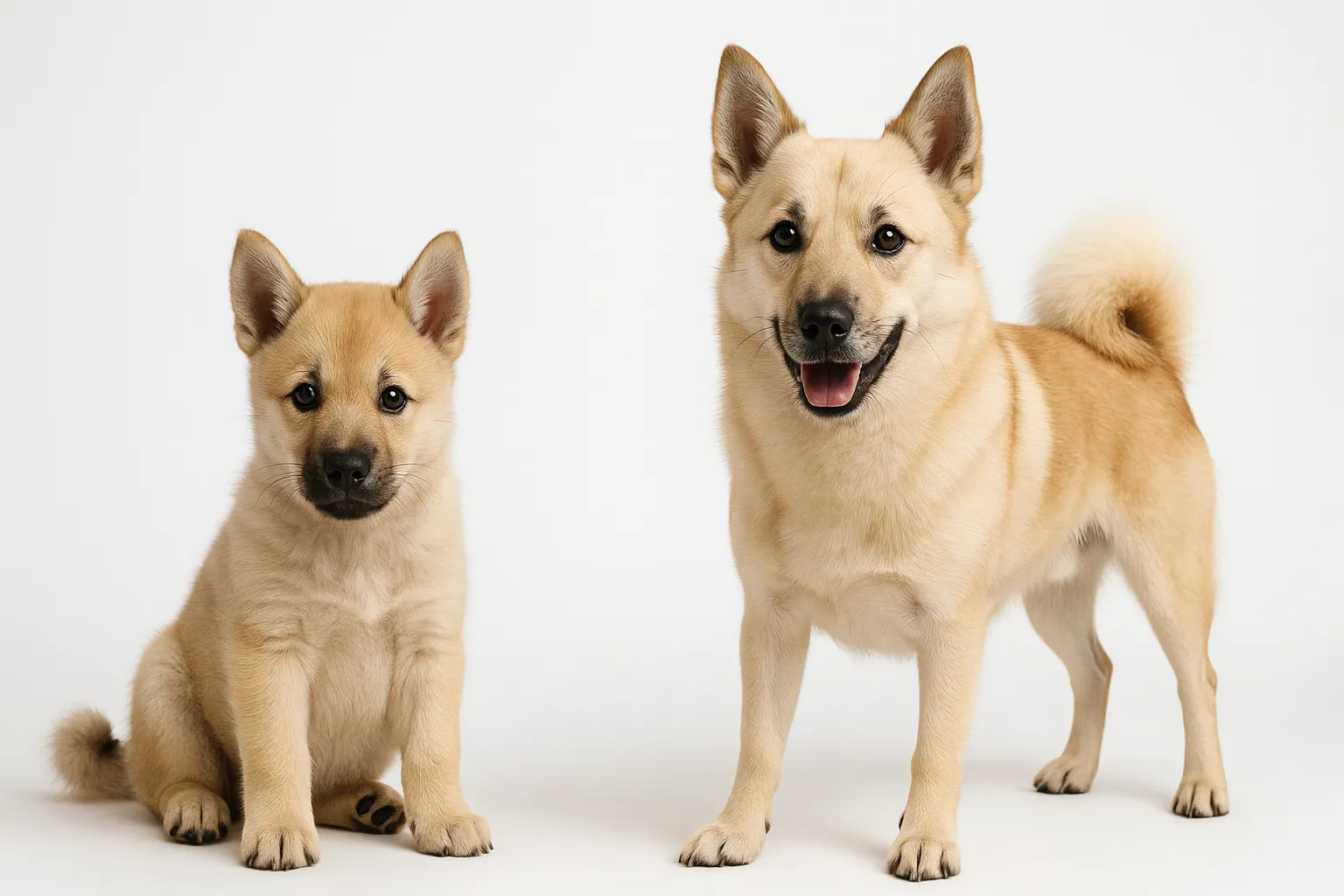
Buried With Vikings — and Still Outliving Most Working Breeds
Few medium-sized working breeds outlive the Norwegian Buhund. Archaeologists found remains of Buhund-type dogs in Viking ship burial mounds dating to 900 AD, making this one of the oldest documented Nordic herding lines still active today.
At 26-40 lbs with a wheaten or wolf-sable double coat and characteristic curled tail, the Buhund combines genuine working drive with a remarkably long life. Most individuals reach 13-15 years — exceptional for a medium herding breed. That longevity owes much to the breed’s ancient origins: centuries of natural selection without extreme morphological exaggeration left the Buhund structurally sound.
The health picture is favorable but not without concerns. Hip dysplasia tops the structural risk list. Progressive retinal atrophy is documented and testable. Epilepsy occurs at above-average rates. None of these conditions is inevitable, and all respond well to early screening and proactive management.
Key Health Challenges
Hip Dysplasia
Hip dysplasia stands as the primary orthopedic concern for Norwegian Buhunds. An OFA hip evaluation at 24 months gives you a structural baseline — and for breeding decisions, it is essential.
Keeping your Buhund lean throughout life reduces clinical severity significantly, because this breed’s active nature means hip integrity directly governs how much exercise they can sustain across a 13-15 year lifespan.
See the Hip Dysplasia guide for full prevention and management detail.
Progressive Retinal Atrophy
Progressive retinal atrophy has been documented in Norwegian Buhunds, and DNA testing for prcd-PRA and other mutations is available for all breeding stock. Annual CAER exams starting at age 1 provide ongoing clinical surveillance. PRA causes progressive bilateral vision loss that typically begins with night blindness. Responsible breeders test every dog and avoid carrier-to-carrier pairings.
See the Progressive Retinal Atrophy guide for full prevention and management detail.
Epilepsy
Norwegian Buhunds develop epilepsy at above-average rates. Two or more unprovoked seizures call for a full neurological evaluation. Anticonvulsant therapy, paired with drug level monitoring every 6 months, manages idiopathic epilepsy effectively in most cases. The Norwegian Buhund Club of America tracks epilepsy incidence to support ongoing research into the genetic basis of this condition.
See the Epilepsy guide for full prevention and management detail.
Science-Backed Longevity Strategies
Channel the Viking Herding Drive
These dogs worked alongside Norsemen for centuries, herding sheep and cattle and guarding remote farmsteads. That working drive is genuine and substantial despite their moderate size. Plan for 60-90 minutes of vigorous daily exercise and meaningful mental engagement.
Buhunds excel in agility, obedience, nose work, and herding trials. Without adequate outlets, they grow vocal — they are an alert, barking breed by nature — and inventive in ways you will not appreciate. Their intelligence and trainability make them outstanding performance dog candidates when given the chance to work.
Caring for the Spitz Double Coat
The Buhund’s dense double coat sheds heavily twice a year during seasonal coat blows. Brush daily during those periods, weekly otherwise. Matting prevention is the goal.
Never shave this coat. It insulates against both cold and heat. Regular ear inspection and cleaning prevents otitis, a common issue in double-coated breeds. The wheaten and wolf-sable coat colors are breed hallmarks — proper grooming maintains both coat health and appearance.
Planning for a Long Nordic Life
A Norwegian Buhund who reaches 12 has a realistic expectation of 3 or more additional years. That is one of the longer remaining-life expectations among medium herding breeds at that age.
Start senior care planning around age 10: biannual wellness visits, annual dental cleaning, cognitive function tracking, and proactive mobility assessment. Their Viking working heritage supports exceptional longevity, but only when preventive care stays consistent through the later years.
Start Here: Your Top Longevity Targets
If you focus on three things for your Norwegian Buhund, make it these:
- OFA hip evaluation at 24 months — hip dysplasia is the primary orthopedic concern
- Annual CAER eye exam from age 1 — progressive retinal atrophy documented in Buhunds
- Monitor for epilepsy — seizures documented at above-average rates in Norwegian Buhunds
Use these priorities to structure your veterinary conversations and home monitoring routine. The condition guides — Hip Dysplasia, Progressive Retinal Atrophy Pra, Seizures Epilepsy — provide the clinical detail behind each recommendation.
Evidence-Based Longevity Priorities
Keep Them Lean and Strong
Maintaining stable weight and lean muscle mass is one of the highest-yield longevity interventions available for any Norwegian Buhund. Body composition stability directly predicts orthopedic longevity and cardiovascular reserve in medium breeds. These herding dogs depend on sustained movement patterns, and stable muscle-to-fat ratios protect their joints over the long haul.
Stack Prevention Around the Biggest Risks
The conditions that most threaten longevity and quality of life — Hip Dysplasia, Progressive Retinal Atrophy Pra, Seizures Epilepsy — are also the ones most responsive to early, sustained prevention. Start here.
Protect Routine and Recovery
Daily routine quality directly affects how Buhunds age. Unpredictable schedules and insufficient mental work often show up as behavior drift, sleep disruption, or slow recovery — sometimes well before physical decline becomes obvious. Structure matters for this breed.
Screen Before Symptoms Appear
Schedule veterinary reassessment intervals by age band and trend changes rather than waiting for obvious deterioration. Planned checkpoints focused on orthopedic function and gait quality improve early detection and intervention timing.
Breed-Specific Research
Use these evidence deep dives to add mechanism-level context to your Norwegian Buhund longevity plan:
- Genetic Testing For Dogs Clinical Roi: PRA genetic testing and epilepsy monitoring in Norwegian Buhunds
- Senior Dog Screening Protocol: extended senior monitoring for a medium breed commonly living 13-15 years
- Exercise Prescription By Life Stage: exercise management for an active Nordic herding breed
Using DNA Data to Guide Prevention
Genetic testing should drive your monitoring strategy, not replace it. Use results to tighten surveillance windows and calibrate when to escalate. Consider MDR1 gene testing for medication safety and hip and elbow scoring (OFA or PennHIP) to quantify orthopedic risk as part of the initial assessment.
- Run a breed-relevant panel and convert the findings into a concrete monitoring timeline. Results that do not change your screening calendar were not worth running.
- Anchor your initial monitoring to Hip Dysplasia and Progressive Retinal Atrophy Pra. Testing matters when it changes what you measure, how often, and what triggers escalation.
- Your Norwegian Buhund’s health story unfolds across years, not appointments. A continuous record linking genetic data, lab trends, and daily observations makes each veterinary conversation more productive.
- Return to your test results whenever something changes — a new lameness, unexplained weight loss, or behavioral shift. Static data becomes useful again when the clinical context moves.
Testing has the most value when it changes what you measure this quarter.
Breeding History & Health Implications
The Buhund was bred for sustained movement, vigilance, and rapid decision-making under workload. That heritage directly shapes today’s health risks and prevention strategy.
- The mechanical stress this breed’s frame sustains over a lifetime makes orthopedic surveillance a non-negotiable part of the prevention plan.
- Focus your risk surveillance on Hip Dysplasia, Progressive Retinal Atrophy Pra, Seizures Epilepsy — these are the conditions where this breed’s ancestry creates the most actionable risk profile.
- When you see the same subtle finding twice — a slight limp, a missed meal, a slower recovery — treat it as a signal, not a coincidence. Tighten your monitoring before it compounds.
- Prevention strategies that never get updated become prevention rituals. Revisit yours regularly and adjust based on what the data actually shows.
Use breeding history to build the initial watchlist. Use your dog’s own health trends to decide when surveillance becomes intervention.
Preventive Care Timeline
- Puppy: prcd-PRA DNA testing, baseline exam
- 1-2 years: OFA hip evaluation, CAER exam, epilepsy monitoring
- 3-9 years: annual CAER exam, wellness bloodwork every 2 years, seizure monitoring
- 10+ years: biannual senior panel, mobility assessment, dental care, cognitive monitoring
What and How to Feed
Norwegian Buhunds do well on quality medium-breed adult food. Their high activity level demands caloric intake calibrated to actual exercise output. Lean body condition supports hip health across their long lifespan, and omega-3 supplementation benefits coat, joint, and cognitive function.
One thing to remember: Nordic working dog heritage gave them efficient metabolisms. It is surprisingly easy to overfeed a Buhund.
How the Pieces Connect
Norwegian Buhunds who receive OFA hip screening, prcd-PRA testing, annual CAER surveillance, and appropriate high-energy herding enrichment are well-positioned to reach 13-15 years with excellent quality of life. Their Viking heritage supports exceptional longevity among medium herding breeds — and with consistent preventive care, most owners can expect their Buhund to be an active companion well into the teens.
Most-Missed Early Drift Pattern
Early disease progression in Norwegian Buhunds usually presents as low-grade changes that owners attribute to normal aging:
- Subtle hind-limb stiffness after rest related to Hip Dysplasia that owners often dismiss as temporary
- A mild early sign tied to Progressive Retinal Atrophy Pra that appears intermittently
- A mild early sign tied to Seizures Epilepsy that appears intermittently
If baseline function is drifting for 7-10 days, treat it as a prevention failure signal and reassess early.
Additional Health Risks to Monitor
Based on breed predisposition data, Norwegian Buhund owners should also be aware of:
Frequently Asked Questions
How long do Norwegian Buhunds live?
Norwegian Buhunds typically live 13-15 years, exceptional for a medium herding breed. OFA hip evaluation, prcd-PRA genetic testing, and annual CAER exams are the primary longevity investments.
Are Norwegian Buhunds one of the oldest dog breeds?
Norwegian Buhunds are among the older documented breeds — Buhund-type dogs were found in a Viking burial mound from 900 AD. They are among the ancient Spitz breeds of Scandinavia with a documented history spanning more than 1,000 years.
Are Norwegian Buhunds good family dogs?
Norwegian Buhunds are affectionate, active, and intelligent — excellent family dogs for active owners. Their herding drive and vocal nature require management, especially in multi-dog households or apartment settings.
Do Norwegian Buhunds bark a lot?
Yes — Norwegian Buhunds are naturally alert and vocal. Their guarding heritage means they alert to unfamiliar sounds and people. Training to control excessive barking is important, particularly in apartment or urban settings.
Are Norwegian Buhunds rare?
Norwegian Buhunds are uncommon in North America but more numerous in Scandinavia where they are a recognized national breed. Following AKC recognition in 2009, North American availability has improved but remains limited.
References
[1] Norwegian Buhund Club of America. norwegianbuhund.org. [2] Gokstad Viking ship burial: excavation records, University of Oslo. [3] OFA health statistics. ofa.org. [4] AKC breed information. akc.org. [5] Nordic Spitz breed history: Nordic Kennel Union records.
Related reads
Related Reading
Continue exploring