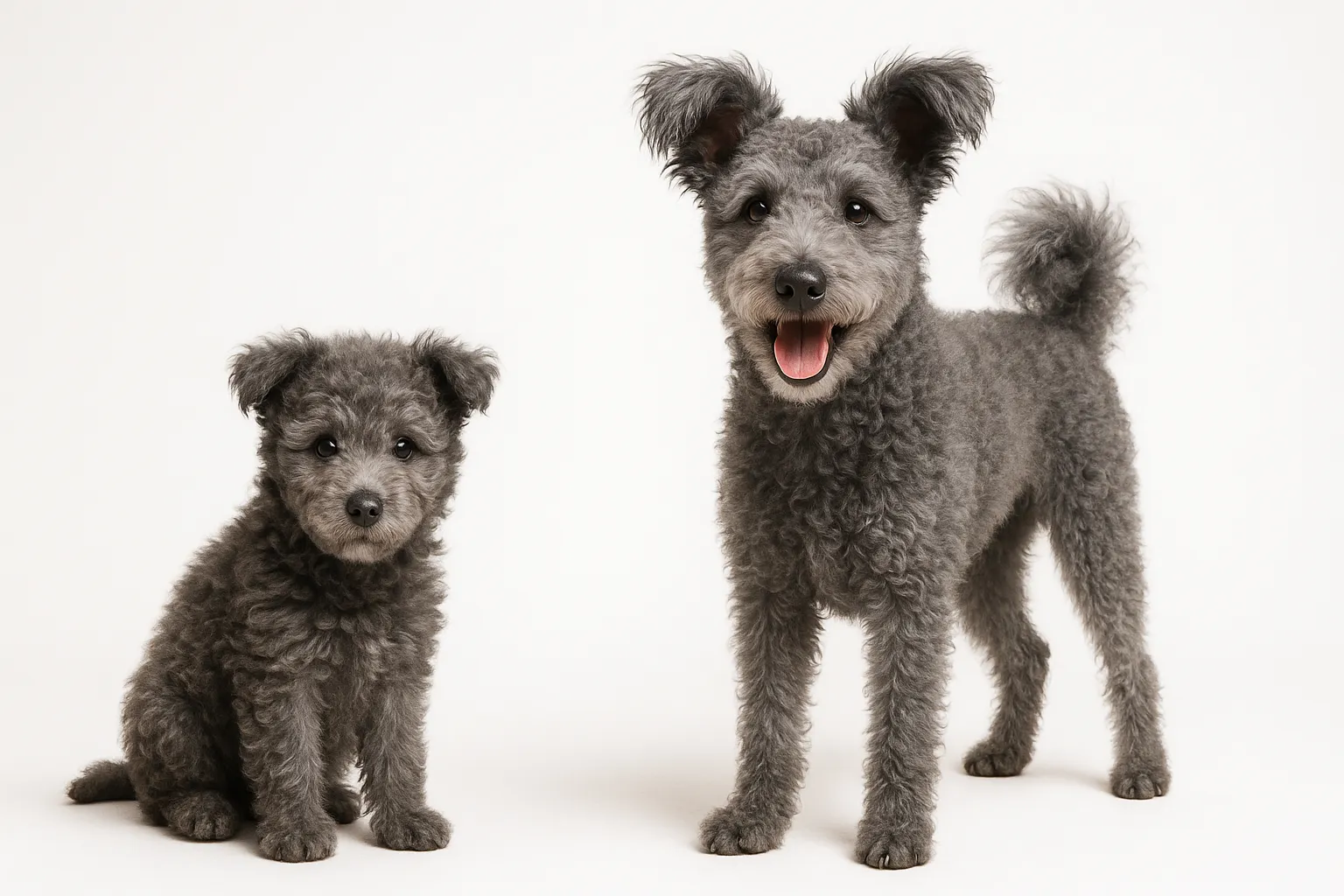
The Puli’s Terrier-Like Cousin — With a Degenerative Myelopathy Risk Worth Knowing
Smaller and more terrier-like than its cousin the Puli, the Pumi (plural: Pumik) is a distinctive Hungarian herding breed with a curly gray or white coat and characteristic semicircular ear tips. Hungarian breeders developed them from crosses of native herding dogs with German and French terriers in the 17th-18th centuries, producing sharp-witted, energetic, and vocal working dogs.
At 22-29 lbs with lifespans of 12-13 years, Pumik face three primary health concerns: hip dysplasia, progressive retinal atrophy, and degenerative myelopathy. The last deserves particular attention — elevated SOD1 mutation frequency has been documented in the breed.
The Health Landscape for This Breed
Hip Dysplasia
Hip dysplasia is the primary orthopedic concern in Pumik. OFA hip evaluation at 24 months provides a structural baseline for breeding decisions. Lean body condition throughout life reduces clinical severity. Because these dogs live to work at high intensity, hip integrity directly affects exercise performance across the full lifespan.
See the Hip Dysplasia guide for full prevention and management detail.
Progressive Retinal Atrophy
PRA is documented in Pumik. DNA testing for prcd-PRA and other mutations is important for breeding stock. Annual CAER exams from age 1 provide ongoing surveillance. PRA causes progressive vision loss beginning with night blindness. Responsible breeders test all stock before breeding.
See the Progressive Retinal Atrophy guide for full prevention and management detail.
Degenerative Myelopathy
Degenerative myelopathy (DM) is a progressive inherited neurological disease that causes hindlimb paralysis. The SOD1 gene mutation frequency is elevated in Pumik. DNA testing identifies clear, carrier, and at-risk (homozygous) dogs.
DM is not preventable, but knowing risk status changes how aggressively you monitor. At-risk dogs have elevated lifetime DM probability, with onset typically at 8 years or older.
See the Degenerative Myelopathy guide for full prevention and management detail.
Practical Longevity Strategies
Curly-Corded Coat Maintenance
The Pumi’s characteristic curly coat forms natural ringlets — not the tight cords of the Puli. Maintaining those ringlets requires regular combing and occasional wetting. Flat brushing breaks up the curls and creates a frizzy appearance, so technique matters.
Professional grooming assistance helps maintain the characteristic coat properly. Trim every 4-6 months. Regular ear inspection and cleaning is especially important in a breed where the curved ear tips can trap debris.
High-Energy Hungarian Working Drive
Pumik are high-energy, sharp, and vocal herding dogs. They were used to herd all types of livestock — cattle, pigs, and sheep — and their versatility reflects genuine intelligence combined with working drive. Without 60+ minutes of vigorous daily exercise and mental engagement, Pumik become anxious and vocal.
They excel in agility, herding, obedience, and flyball. Their alert, quick-thinking nature makes them outstanding sport dogs but genuinely challenging for low-engagement owners.
DM Risk Monitoring and Planning
Pumik with elevated DM risk (homozygous SOD1 at-risk genotype) should have neurological baseline assessments from age 7-8. Early DM presents as hindlimb incoordination or weakness that owners sometimes initially attribute to arthritis or fatigue.
Distinguishing DM from IVDD or other spinal conditions requires MRI and CSF analysis. While DM is not treatable, physical rehabilitation extends mobility duration. Physiotherapy maintains muscle mass and improves quality of life in early-stage disease.
The Three Things That Matter Most
These are the investments that pay the highest longevity dividend for a Pumi:
- OFA hip evaluation at 24 months — hip dysplasia is the primary orthopedic concern in Pumik
- DNA testing for progressive retinal atrophy (prcd-PRA) — documented in the breed
- DNA testing for degenerative myelopathy (DM) — elevated SOD1 mutation frequency documented in Pumik
The conditions listed above are where proactive monitoring pays the highest dividend for this breed. Make them the backbone of your prevention plan. See Hip Dysplasia, Progressive Retinal Atrophy Pra, Degenerative Myelopathy for the full breakdown.
Evidence-Based Longevity Priorities
Body Composition and Muscle Maintenance
Body composition predicts long-term function more reliably than most other single factors in the Pumi. As a small breed, lean mass retention becomes critical around middle age when metabolic rate begins to slow. Sustained herding movement patterns require stable muscle-to-fat ratios for long-term joint health.
Condition-Focused Prevention Stack
The greatest healthspan gains come from focusing prevention on Hip Dysplasia, Progressive Retinal Atrophy Pra, Degenerative Myelopathy. Acting at the first credible signal, rather than waiting for certainty, is what separates dogs who maintain function from those who lose it.
Behavior, Stress Load, and Recovery
Pumik maintain better long-term stability when workload, recovery, and mental stimulation are intentionally balanced. Without structured cognitive engagement, these dogs often develop compulsive behaviors or chronic stress patterns that erode healthspan.
Preventive Screening Cadence
Do not wait for a crisis to prompt a vet visit. Scheduled screening intervals — tied to the breed’s specific risk profile — catch the kind of slow, subtle drift that crisis-driven care consistently misses.
Breed-Specific Research
Use these evidence deep dives to add mechanism-level context to your Pumi longevity plan:
- Genetic Testing For Dogs Clinical Roi: PRA and DM genetic testing decisions for Pumik
- Hip Dysplasia Lifetime Load Management: hip dysplasia management in a high-energy herding breed
- Exercise Prescription By Life Stage: exercise management for an active Hungarian herding breed
How to Use Genetic Panel Results
The practical value of genetic testing in the Pumi comes from linking results to monitoring cadence and owner action, not from treating test data as predictive certainty. MDR1 gene testing guides medication safety; hip and elbow scoring (OFA or PennHIP) quantifies orthopedic risk as part of the initial assessment.
- A well-chosen initial panel gives you a risk map. Follow-up assessments at regular intervals tell you which risks are materializing and which remain theoretical.
- Anchor your initial monitoring to Hip Dysplasia and Progressive Retinal Atrophy Pra. Testing matters when it changes what you measure, how often, and what triggers escalation.
- Keep a unified record of all test results, vet findings, and home observations. The connections that matter most — slow trends, seasonal patterns — only show up when all the data lives in one place.
- Each time your Pumi enters a new life stage or shows a persistent change in function, go back to the genetic data and ask what it means in the new context.
Every genetic or diagnostic result should answer one question: what do I do differently starting now?
Breeding History & Health Implications
The Pumi was bred for sustained movement, vigilance, and rapid decision-making under workload. That heritage shapes both the structural demands and the temperament sensitivity these dogs carry.
- Structural load and temperament sensitivity require monitoring frequency calibrated to actual risk, not just annual wellness defaults.
- Focus your risk surveillance on Hip Dysplasia, Progressive Retinal Atrophy Pra, Degenerative Myelopathy — these are the conditions where this breed’s ancestry creates the most actionable risk profile.
- Repeated low-grade signals are how most chronic conditions announce themselves. Respond to the pattern, not just the individual data point.
- Static prevention plans decay in value. The most effective owners treat their Pumi’s health plan as something that evolves with every vet visit and every home observation.
Breeding history narrows the search. Serial monitoring data makes the call.
Monitoring Schedule by Life Stage
- Puppy: prcd-PRA DNA testing, DM DNA testing, baseline exam
- 2 years: OFA hip evaluation, CAER exam, wellness baseline
- 3-8 years: annual CAER exam, wellness bloodwork every 2 years
- 9+ years: DM monitoring if at-risk, biannual senior panel, mobility assessment
Nutrition That Supports a Longer Life
Pumik do well on quality small-breed adult food. Their high energy level requires caloric intake calibrated to exercise output. Lean body condition supports hip health. Omega-3 supplementation supports coat quality (maintaining those healthy ringlets), joint function, and cognitive health.
The Longevity Picture
Pumik with OFA hip evaluation, prcd-PRA and DM genetic testing, annual CAER surveillance, and appropriate high-energy herding enrichment can achieve their 12-13 year longevity potential. Their Hungarian working heritage supports functional health — the key is matching that genetic advantage with proactive management of the breed-specific risks.
Most-Missed Early Drift Pattern
Long-term decline in Pumik often starts as small changes that owners normalize too quickly:
- Subtle hind-limb stiffness after rest related to Hip Dysplasia that owners often dismiss as temporary
- A mild early sign tied to Progressive Retinal Atrophy Pra that appears intermittently
- Gradual drift toward Degenerative Myelopathy signs that become harder to reverse: progressive loss of hindquarter coordination and muscle mass
If baseline function is drifting for 7-10 days, treat it as a prevention failure signal and reassess early.
Additional Health Risks to Monitor
Based on breed predisposition data, Pumi owners should also be aware of:
Frequently Asked Questions
How long do Pumik live?
Pumik typically live 12-13 years. OFA hip evaluation, prcd-PRA and DM genetic testing, and annual CAER eye exams are the primary longevity investments.
What is the plural of Pumi?
The plural of Pumi in Hungarian is Pumik. Both “Pumi” (singular) and “Pumik” (plural) are used in English-language breed discussions.
Are Pumik related to the Puli?
The Pumi and Puli share ancient Hungarian herding dog ancestry. The Pumi was developed from the Puli through crosses with German and French herding breeds, creating a smaller, more terrier-like working dog. Both are recognized Hungarian herding breeds but are genetically distinct.
Are Pumik good family dogs?
Pumik are loyal, energetic, and intelligent — suitable for active families who can meet their significant exercise and mental engagement requirements. Their alert, vocal nature requires management in urban or apartment settings.
Do Pumik have corded coats like the Puli?
No — Pumik have curly ringlet coats rather than the full corded coat of the Puli. The Pumi coat forms natural curls that require periodic wetting and combing to maintain ringlet formation, not the extensive cording maintenance of Puli coats.
References
[1] Pumi Club of America. pumiclubofamerica.org. [2] DM genetics in herding breeds: Awano T et al. N Engl J Med. 2009. [3] OFA health statistics. ofa.org. [4] AKC breed information. akc.org. [5] Hungarian herding breed history: Magyar Kennel Club records.
Related reads
Related Reading
Continue exploring