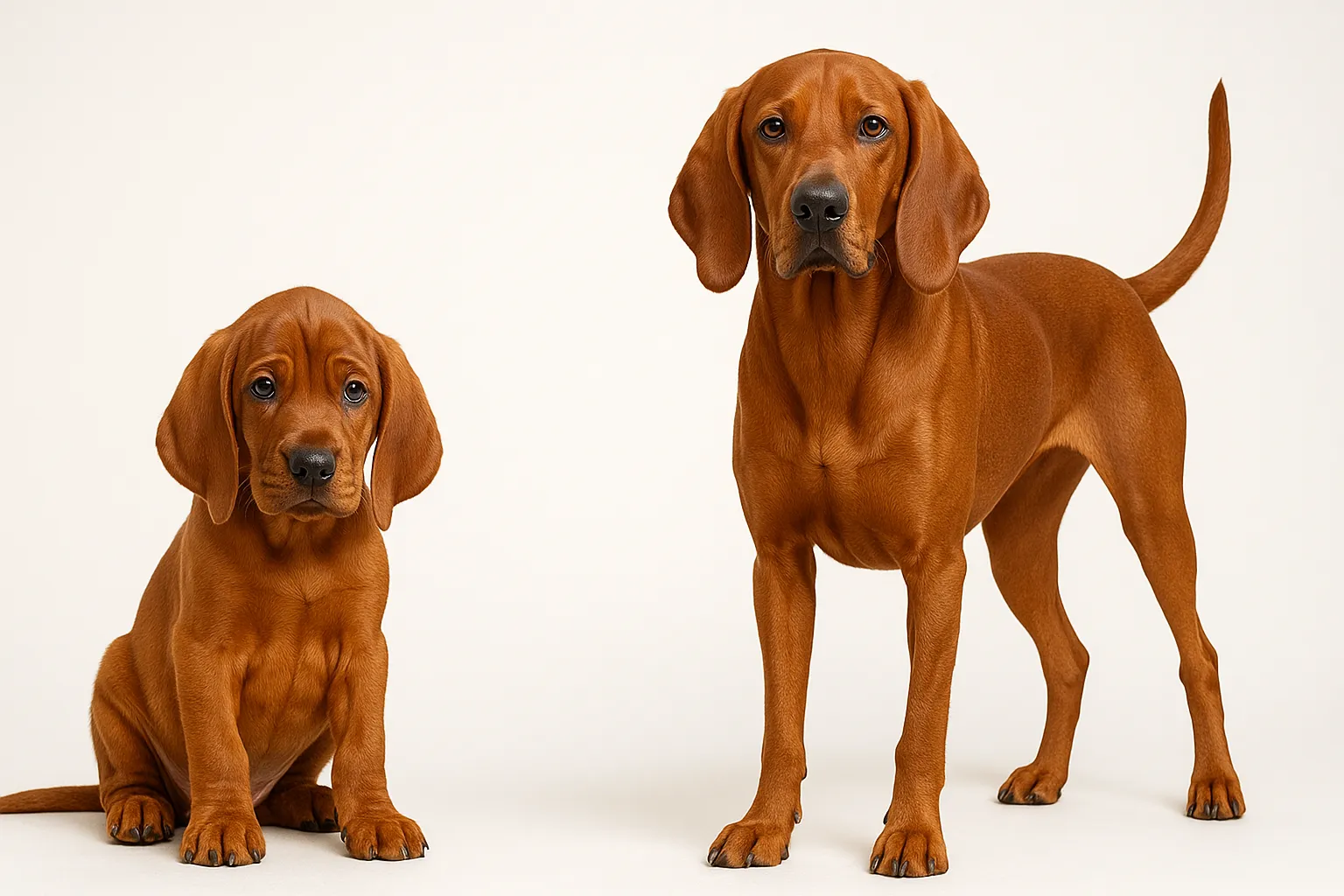
America’s Red-Coated Scent Hound — and What Keeps It Running
Few breeds announce themselves like the Redbone Coonhound. That deep, musical baying voice carries across water and rough terrain, and it has been doing so since Peter Redbone of Tennessee crossed Scottish foxhounds with Bloodhound-type stock to create America’s signature red-coated scent hound. Redbones typically live 11-12 years.
Their health profile follows the classic coonhound pattern: moderate hip dysplasia risk, chronic ear disease driven by pendulous ear anatomy, and GDV susceptibility from a deep chest. On the upside, the breed does not carry prominent single-gene disorders as of 2026, and their diverse working heritage likely supports reasonable genetic variety.
The Health Conditions That Define This Breed
Hip Dysplasia
Hip dysplasia occurs in Redbones at rates typical for large working hounds. An OFA hip evaluation at 24 months gives you a structural baseline to build on. From there, weight management and omega-3 supplementation are the two modifiable factors that matter most.
See the Hip Dysplasia guide for full prevention and management detail.
Ear Infections (Otitis Externa)
Those gorgeous pendulous ears are also a liability. They trap moisture, block airflow to the canal, and create ideal conditions for infection. Weekly cleaning and thorough post-water drying are non-negotiable. When infections do occur, culture-guided treatment prevents the cycle of recurrence that leads to chronic, treatment-resistant otitis.
See the Ear Infections (Otitis Externa) guide for full prevention and management detail.
Bloat (GDV)
Deep-chested conformation puts Redbones at risk for gastric dilatation-volvulus. Prophylactic gastropexy at spay/neuter eliminates the volvulus component. Feeding twice daily and skipping vigorous post-meal exercise add further protection.
See the Bloat (GDV) guide for full prevention and management detail.
Science-Backed Longevity Strategies
Ear Management for Hunting Dogs
If your Redbone works water, ear infection risk compounds with every swim. Dry those ears immediately after water exposure — do not wait until you get home. A veterinarian-recommended drying cleanser used weekly maintains canal health between hunts. Head shaking, scratching, odor, or discharge means the infection has already started. Treat it promptly, because early otitis responds to treatment far better than the chronic form.
Body Condition in Working Hounds
A Redbone in hunting shape is lean and muscular. A Redbone on the couch is a different story. Without regular work, this breed gains weight easily, and that weight accelerates hip dysplasia progression faster than almost any other factor. Score body condition monthly and measure portions rather than eyeballing them. You should see a defined waist and feel ribs without pressing through a fat layer. A lean Redbone lives longer and moves better than one carrying even modest excess weight.
Breed-Specific Health Research
Redbones are less studied than popular companion breeds For hereditary conditions. Their working-dog origins and diverse breeding history likely provide a degree of genetic resilience. Still, that is not a reason to skip monitoring. Watch for emerging data through breed clubs and OFA, and treat research gaps as a reason for vigilance rather than complacency.
Priority Actions for a Longer Life
These are the investments that pay the highest longevity dividend for a Redbone Coonhound:
- OFA hip evaluation at 24 months given moderate hip dysplasia prevalence in coonhound breeds
- Weekly ear cleaning — pendulous hound ears require lifelong consistent care to prevent chronic disease
- Prophylactic gastropexy for GDV prevention given deep-chest anatomy
Build your annual wellness calendar around these targets. Review progress quarterly and shift resources toward whichever risk area is trending fastest. See Hip Dysplasia, Ear Infections, Bloat for detailed protocols.
Evidence-Based Longevity Priorities
Body Composition and Muscle Maintenance
Weight stability and muscle quality form the foundation of orthopedic health in this breed. Joint load and metabolic strain escalate quickly when body composition drifts, so prevention needs to stay ahead of the curve. These pursuit athletes rely on sustained lean mass to keep joints functional and cardiovascular output efficient.
Condition-Focused Prevention Stack
Concentrate your prevention investment on Hip Dysplasia, Ear Infections, Bloat. These are the conditions where the gap between early and late action is widest, and the cost of delay is steepest.
Behavior, Stress Load, and Recovery
Redbones do best when scent enrichment, controlled exercise, and genuine downtime are deliberately balanced. Without adequate sensory engagement, these dogs may develop chronic stress behaviors or obsessive patterns that erode wellbeing over time.
Preventive Screening Cadence
Set routine veterinary checkpoints and tighten the schedule when orthopedic function or gait quality starts to shift. Prevention windows close quickly once symptoms become obvious — by then, you have already lost ground.
Breed-Specific Research
Use these evidence deep dives to add mechanism-level context to your Redbone Coonhound longevity plan:
- Exercise Protocols By Breed Size: exercise management for large working scent hounds
- Canine Obesity And Lifespan Evidence: weight management evidence for hound breeds prone to weight gain in non-working settings
- Annual Wellness Testing Protocol For Dogs: wellness monitoring framework for working hound breeds
Using DNA Data to Guide Prevention
Genetic testing has the most practical value when it changes what you actually measure and how often. For Redbones, consider hip and elbow scoring (OFA or PennHIP) to quantify orthopedic risk and a CERF eye exam or PRA gene test to detect heritable eye disease as part of the initial risk assessment.
- A breed-appropriate genetic panel gives you a starting point. Convert each result into a follow-up interval and a specific metric to track over time.
- Tie your first monitoring plan to Ear Infections and Hip Dysplasia so test results translate into practical follow-through.
- Create a health timeline that follows your Redbone Coonhound across life stages. Include test results, clinical findings, medications, and home observations — it turns isolated data points into a readable trajectory.
- The most important reassessment windows come at the transitions: growth to adulthood, adulthood to middle age, and middle age to senior status. Recalibrate at each one.
The right time for a test is when its results will change a specific, near-term decision. That is when testing delivers actual value.
Breeding History & Health Implications
The Redbone was bred for tracking endurance, pursuit speed, and scent-driven work over rough terrain. That history creates a risk profile you can address through structured prevention.
- The mechanical stress this breed’s frame sustains over a lifetime makes orthopedic surveillance a non-negotiable part of the prevention plan.
- Prioritize surveillance around Ear Infections, Hip Dysplasia, Obesity based on history-informed risk triage.
- Repeated low-grade signals are how most chronic conditions announce themselves. Respond to the pattern, not just the individual data point.
- Lock in a regular cadence for reviewing your monitoring plan — at minimum every three to four months. What you should be watching for at five years old is different from what mattered at two.
Let history guide what to watch first. Let trend data confirm what to change next.
Age-Based Monitoring Milestones
- Puppy to 2 years: OFA hip at 24 months, establish ear care routine
- 3-7 years: monthly ear care, annual wellness panel, body condition monitoring
- 8+ years: senior panel annually, orthopedic pain assessment
Diet and Feeding Strategy
Redbones thrive on complete large-breed adult diets with careful caloric management. Working dogs burn more and need higher intake; household pets need measured portions to avoid creep. Omega-3 supplementation supports joint health. Feed twice daily given GDV risk — never once in a large bolus.
The Healthspan Horizon
Redbones are generally robust working hounds with a relatively clean genetic health profile. The formula is straightforward: consistent ear care, lean body condition, and hip screening. Owners who stay disciplined on these fundamentals can expect most Redbones to reach the 11-12 year typical range in good working condition.
Most-Missed Early Drift Pattern
Long-term decline in a Redbone often starts as small changes that owners normalize too quickly:
- Head tilting or occasional ear scratching related to Ear Infections that gets dismissed as a minor annoyance
- Subtle compensation patterns masking Hip Dysplasia progression: bunny-hopping gait or reluctance to jump
- Gradual drift toward Obesity that becomes harder to reverse once exercise intolerance, joint stress, and secondary disease acceleration set in
If baseline function has been drifting for 7-10 days, treat it as a prevention failure signal and reassess early.
Additional Health Risks to Monitor
Based on breed predisposition data, Redbone Coonhound owners should also be aware of:
Frequently Asked Questions
How long do Redbone Coonhounds live?
Redbone Coonhounds typically live 11-12 years. Consistent ear care, hip OFA evaluation, and prophylactic gastropexy are the key longevity investments.
Are Redbone Coonhounds good family pets?
Redbones are affectionate and gentle with family. They need significant daily exercise and secure fencing — their scent drive makes them unsafe off-leash in unsecured environments.
Are Redbone Coonhounds easy to train?
They are intelligent for tracking work but can be independent and selectively responsive to commands. Positive reinforcement training with food rewards works best. Formal obedience training helps manage their independent streak.
Do Redbone Coonhounds smell?
Like most hound breeds, Redbones have a characteristic “hound smell” — a natural body odor more pronounced than in many other breeds. Regular bathing and grooming manage it but do not eliminate it entirely.
Are Redbone Coonhounds good swimmers?
Yes — Redbones are excellent swimmers, specifically developed for trailing game through water. Swimming doubles as outstanding low-impact exercise for the breed.
References
[1] National Redbone Coonhound Association health resources. [2] OFA health statistics by breed. ofa.org. [3] WSAVA global nutrition guidelines. wsava.org. [4] Ear disease management in dogs: Noxon JO. Vet Clin North Am. 2016. [5] Canine hip dysplasia: Morgan JP et al. JAVMA. 2000.
Related reads
Related Reading
Continue exploring