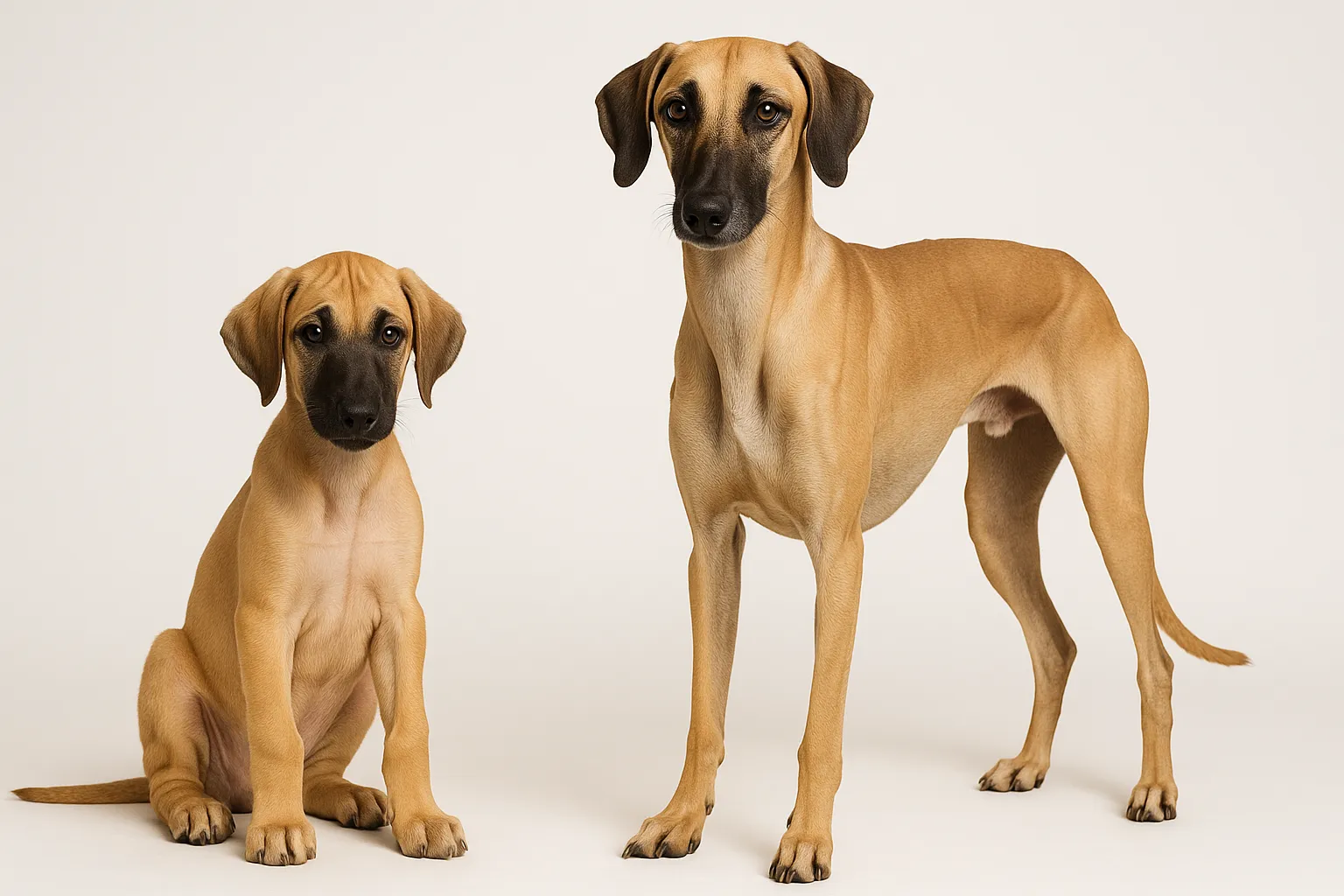
7,000 Years of Desert Running — and a Sighthound Physiology That Changes Everything
The Sloughi has been running across North African desert for at least seven millennia. Berber and Arab peoples used this lean, elegant sighthound — sometimes called the Arabian Greyhound — to hunt hare, fox, gazelle, and jackal. It ranks among the oldest breeds in existence. They live 12-16 years, a strong range for a large dog.
Their primary health concerns reflect both genetics and sighthound physiology. Progressive retinal atrophy (PRA) is the most significant inherited condition, with DNA testing available. Standard sighthound vulnerabilities apply: anesthesia sensitivity from minimal body fat altering barbiturate metabolism, and GDV risk from the characteristic deep-chested conformation. Cardiac screening for DCM is appropriate from middle age.
Where This Breed Is Most Vulnerable
Progressive Retinal Atrophy
PRA is the most significant documented inherited condition in Sloughis. DNA testing identifies clear, carrier, and affected dogs. The disease causes progressive bilateral vision loss, beginning with night blindness and advancing to full blindness. Annual CAER exams detect early clinical changes. Responsible breeding using DNA-tested clear dogs prevents PRA from being passed to offspring entirely.
See the Progressive Retinal Atrophy guide for full prevention and management detail.
Bloat (GDV)
Like all deep-chested sighthounds, Sloughis carry elevated GDV risk. The fundamentals apply: feed two smaller meals, use slow feeders, restrict exercise before and after eating. Prophylactic gastropexy at spay/neuter dramatically reduces lifetime GDV risk. This is one of the few interventions where a single procedure changes the lifetime risk equation.
See the Bloat (GDV) guide for full prevention and management detail.
Cardiac Screening
Dilated cardiomyopathy appears in some sighthound lines. Annual cardiac auscultation from age 4 and echocardiography every 2-3 years allow early detection. The Sloughi’s lean, deep-chested build means subtle early signs of cardiac compromise — slightly reduced exercise tolerance, mild weight loss — can be difficult to distinguish from normal sighthound physiology. That ambiguity makes scheduled screening essential.
See the Cardiac Screening guide for full prevention and management detail.
What Actually Moves the Needle
PRA Testing Before Purchasing
Progressive retinal atrophy in Sloughis follows autosomal recessive inheritance. Two carrier parents can produce affected offspring without either parent being visibly affected. Request DNA test certificates for both parents before acquiring a Sloughi puppy. This single step eliminates PRA risk entirely.
The American Sloughi Association and international breed clubs promote mandatory PRA testing for all breeding dogs. It is a solved problem — but only if breeders and buyers enforce the standard.
Sighthound Sensitivity
Sloughis share the characteristic sighthound metabolic profile: minimal body fat, altered hepatic drug metabolism, and sensitivity to cold. Your veterinarian needs to know that Sloughis require sighthound-appropriate anesthesia protocols — propofol or alfaxalone induction, isoflurane maintenance, extended recovery monitoring.
Carry a sighthound anesthesia card in your dog’s records. In an emergency, the attending veterinarian may not have sighthound experience. Cold-weather outerwear for temperatures below 45 degrees F is appropriate — these are desert dogs with minimal subcutaneous insulation.
Cultural Context of a Desert Breed
The Sloughi has been integral to North African Berber culture for millennia, valued as both hunting partner and family companion. They bond deeply to their families but remain reserved or withdrawn with strangers — a characteristic fundamentally different from the social ease of Greyhounds accustomed to crowd handling in racing environments.
Adequate socialization during puppyhood with diverse people, environments, and sounds is essential. This is not a dog that naturally warms to the unfamiliar.
The Three Things That Matter Most
If you focus on three things for your Sloughi, make it these:
- DNA testing for progressive retinal atrophy — PRA is the most documented inherited disease in the breed
- Annual CAER eye exam — multiple inherited eye conditions documented
- Sighthound anesthesia protocol documentation — critical before any surgical procedure
Build your annual wellness calendar around these targets. Review progress quarterly and shift resources toward whichever risk area is trending fastest. See Progressive Retinal Atrophy Pra, Bloat, Cardiac Disease for detailed protocols.
Evidence-Based Longevity Priorities
Body Composition and Muscle Maintenance
Body condition is the single most modifiable longevity factor for a Sloughi — every extra pound of fat amplifies risk across joints, heart, and metabolism simultaneously. In a large breed, joint load and metabolic strain rise quickly when body composition drifts. These pursuit athletes need sustained lean mass to preserve joint function and cardiovascular efficiency — visible ribs are normal, not a sign of underfeeding.
Condition-Focused Prevention Stack
The highest-return prevention investments for Sloughis target Progressive Retinal Atrophy Pra, Bloat, and Cardiac Disease. The cost of early action is almost always lower than the cost of delay — in treatment complexity, in quality of life, and in total lifespan.
Behavior, Stress Load, and Recovery
Household consistency matters more than most Sloughi owners realize. Irregular schedules and insufficient enrichment often present as behavior drift or recovery problems before physical decline becomes apparent.
Preventive Screening Cadence
Proactive scheduling beats reactive visits. Set regular reassessment intervals, then shorten them the moment your tracking log signals a trend change — that is when intervention has the highest return.
Breed-Specific Research
Use these evidence deep dives to add mechanism-level context to your Sloughi longevity plan:
- Genetic Testing For Dogs Clinical Roi: PRA genetic testing decisions for a rare breed with documented inherited eye disease
- Dilated Cardiomyopathy Screening In Dogs: cardiac monitoring relevant for sighthound breeds with documented DCM risk
- Senior Dog Screening Protocol: senior monitoring for a breed with 12-16 year lifespan
Using DNA Data to Guide Prevention
For Sloughis, genetic testing delivers the most value when results directly change what you monitor, how often, and what triggers escalation. Baseline echocardiography to establish cardiac structure and function, plus a CERF eye exam or PRA gene testing to detect heritable eye disease, are strong starting points.
- Match your genetic panel to your breed’s documented risks and build a monitoring playbook around the results. One-time testing without follow-through is just expensive curiosity.
- Link your monitoring plan to Progressive Retinal Atrophy Pra and Heart Disease first. When test results drive concrete changes in screening cadence or intervention, testing earns its cost.
- Create a health timeline that follows your Sloughi across life stages. Include test results, clinical findings, medications, and home observations — it turns isolated data points into a readable trajectory.
- The most important reassessment windows come at the transitions: growth to adulthood, adulthood to middle age, and middle age to senior status. Recalibrate at each one.
The best use of any test is to make your next veterinary conversation more specific and your monitoring plan more targeted.
Breeding History & Health Implications
The Sloughi was bred for tracking endurance, pursuit speed, and scent-driven work across desert terrain. That legacy shapes cardiac aging patterns in modern dogs.
- Cardiac aging demands respiratory rate tracking and murmur reassessment with consistent tracking that adapts as your dog ages — the right interval at three years is not the right interval at eight.
- Channel your prevention effort toward Progressive Retinal Atrophy Pra, Heart Disease, Bloat, the conditions where this breed’s genetic and functional history creates the greatest vulnerability.
- Repeated low-grade signals are how most chronic conditions announce themselves. Respond to the pattern, not just the individual data point.
- Lock in a regular cadence for reviewing your monitoring plan — at minimum every three to four months. What you should be watching for at five years old is different from what mattered at two.
Use breeding history to build the initial watchlist. Use your dog’s own health trends to decide when surveillance becomes intervention.
The Screening Calendar That Matters
- Puppy: confirm PRA DNA testing of both parents before purchase
- 2 years: CAER eye exam, sighthound anesthesia protocol established with vet
- 3-8 years: annual CAER, cardiac auscultation, wellness bloodwork every 2 years
- 9+ years: senior panel annually, cardiac echo, cognitive monitoring
Nutrition That Supports a Longer Life
Feed Sloughis quality large-breed adult food appropriate to their lean athletic body type. Visible ribs and hip bones are normal for a healthy Sloughi — do not overfeed in response to what might look lean to owners of other breeds. Two meals daily reduces GDV risk. Omega-3 supplementation supports eye and cardiovascular health. Sloughis can be somewhat selective eaters; high-quality food prevents palatability problems.
What the Future Can Hold
Sloughis with PRA genetic clearance, appropriate sighthound veterinary protocols, and good socialization can live long, active lives well into their mid-teens. Their ancient Berber heritage represents a distinct genetic lineage with strong longevity for a large breed. With the right owner, these dogs thrive.
Most-Missed Early Drift Pattern
Healthspan erosion in Sloughis typically begins with subtle shifts that are easy to miss:
- Early night blindness tied to Progressive Retinal Atrophy Pra — hesitation in dim environments, bumping into objects at dusk
- Subtle compensation patterns that mask Heart Disease progression: reduced exercise tolerance attributed to aging or heat
- Gradual drift toward Bloat signs that become harder to reverse: unproductive retching, rigid distended abdomen, and rapid deterioration
If baseline function is drifting for 7-10 days, treat it as a prevention failure signal and reassess early.
Additional Health Risks to Monitor
Based on breed predisposition data, Sloughi owners should also be aware of:
Frequently Asked Questions
How long do Sloughis live?
Sloughis typically live 12-16 years. PRA testing, cardiac monitoring, and sighthound anesthesia protocols are the most critical health priorities.
How is Sloughi different from a Saluki?
Both are ancient Middle Eastern/North African sighthounds, but they are distinct breeds. Sloughis are from North Africa (Morocco, Algeria, Tunisia, Libya) and are typically shorter and more lightly built than Salukis. Salukis have feathered ears and tail; Sloughis are smooth-coated throughout.
Are Sloughis good apartment dogs?
Sloughis adapt reasonably to apartment living if given adequate daily exercise (30-60 minutes of running plus walks). They are calm indoors but require an outlet for their speed — off-leash running in a securely fenced area is ideal.
Do Sloughis like other dogs?
Sloughis are generally compatible with other sighthounds and calm dogs they are raised with. As coursing sighthounds, they may view small animals as prey — introductions with cats and small pets require careful management.
Why is the Sloughi so rare?
The Sloughi remains one of the rarest AKC sighthound breeds in North America. Their reserved temperament and cultural rarity in export from North Africa limit population growth compared to breeds with larger global breeder networks.
References
[1] American Sloughi Association. americansloughi.org. [2] PRA in Sloughis: Dekomien G et al. Mol Vis. 2000. [3] North African sighthound history: documented Berber and Arab cultural records. [4] OFA health statistics. ofa.org. [5] AKC breed information. akc.org.
Related reads
Related Reading
Continue exploring