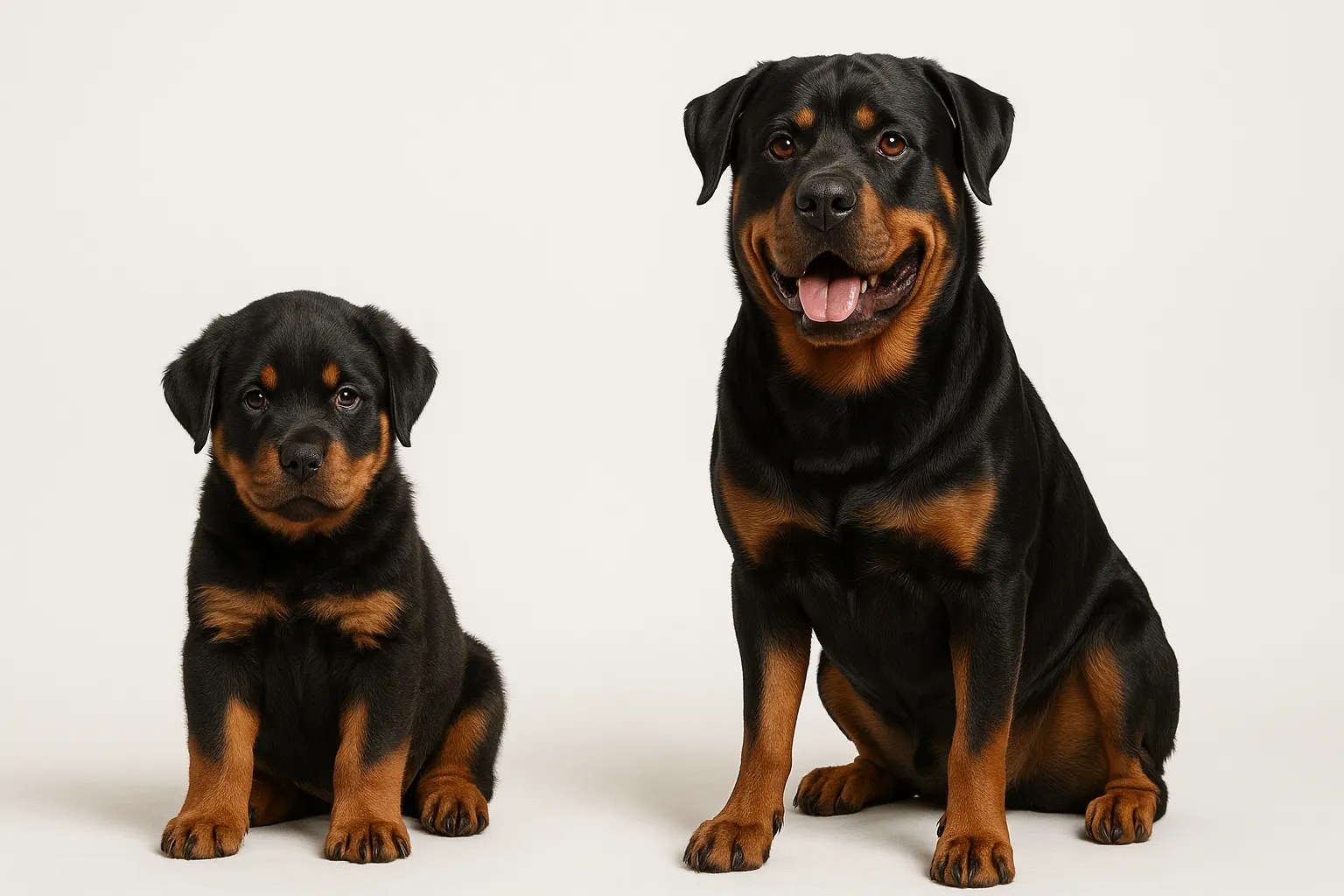
A Powerful Breed on a Short Clock
Most Rottweilers live 8-10 years. That number lands hard when you consider the size of the bond these dogs build with their families. They are intensely loyal, deeply attuned to their people, and physically imposing in a way that makes their eventual decline feel especially abrupt.
The good news: much of what shortens a Rottweiler’s life is preventable or manageable. The bad news: the window for intervention is narrower than in smaller, longer-lived breeds. Every year of prevention counts more here.
The Five Threats That Steal Years
- Orthopedic disease — hip dysplasia and the secondary arthritis it drags behind it
- Cancer — a leading cause of death in older Rottweilers, often detected too late
- Heart disease — frequently silent until it is serious
- Bloat (GDV) — a life-threatening emergency that strikes deep-chested breeds without warning
- Obesity — the accelerant that makes every other risk worse
These five conditions interact. Extra weight loads damaged joints. A dog in pain moves less, which drives further weight gain. Cancer screening gets delayed when the focus shifts to managing pain. This cascade is why holistic prevention matters far more than treating each condition in isolation.
Where the Biggest Risks Live
Hip Dysplasia: The Quiet Erosion of Mobility
Hip dysplasia rarely announces itself with dramatic lameness. More often, you notice a subtle reluctance to climb stairs, a slower rise from the floor, or a slight shift in how your dog distributes weight. By the time an obvious limp appears, structural damage has been accumulating for months or years.
Cancer: Why Early Detection Changes Everything
Rottweilers carry a higher cancer burden than most breeds. Regular lump checks and proactive diagnostics — not a wait-and-see approach — give you the best chance of catching tumors when treatment options are still broad.
Heart Disease: The Signs You Might Dismiss
A slight drop in stamina. A cough that only appears at night. A resting respiratory rate that creeps up by a few breaths per minute. These changes are easy to rationalize. In Rottweilers, they warrant a cardiac workup sooner rather than later.
Bloat (GDV): Minutes Matter
Bloat can kill a healthy dog in hours. Every Rottweiler owner should know the signs — unproductive retching, a distended or rigid abdomen, sudden restlessness — and have a plan for immediate emergency transport. This is not a condition where you wait until morning.
The Five-Point Longevity Framework
- Keep them lean, year-round. The single highest-return investment in your Rottweiler’s healthspan.
- Build strength without joint stress. Low-impact conditioning protects joints while maintaining the muscle mass this breed needs.
- Screen earlier than average. Start cardiac and cancer surveillance before midlife, not after symptoms appear.
- Manage bloat risk through routine. Measured meals on a consistent schedule, with enforced rest after eating.
- Act fast on new findings. Any new mass, collapse episode, or acute abdominal change warrants same-day diagnostics.
Why Body Condition Is the Foundation
A lean Rottweiler is a healthier Rottweiler across virtually every system. Excess weight increases joint load, strains the cardiovascular system, and raises cancer risk. Because this breed was built for draft work and guarding, maintaining lean muscle mass directly extends functional life.
The challenge: Rottweilers are food-motivated and muscular enough that a few extra pounds hide under their frame. Monthly body-condition scoring catches drift before it compounds.
Targeting the Conditions That Matter Most
Hip Dysplasia, Cancer, and Heart Disease represent the highest-yield clinical targets for this breed. Prevention works best when you combine early screening, fast escalation, and consistent follow-through on management plans — addressing these conditions in parallel, not one at a time.
Routine, Stress, and the Working-Breed Mind
Rottweilers thrive on predictability. Stable sleep schedules, structured activity windows, and clear household roles reduce chronic stress — a factor increasingly linked to accelerated aging in dogs. Sustained stress quietly erodes resilience over time.
When to Tighten Your Screening Schedule
Plan veterinary reassessments at regular intervals, then shorten those intervals the moment you see drift in orthopedic function, gait quality, or energy levels. The biggest healthspan gains happen during early intervention, before a condition becomes entrenched.
Research Worth Reading
These evidence-based deep dives add context to the risks Rottweilers face:
- Arthritis Pain Stack for Dogs: Mobility-First Framework: frames prevention and monitoring decisions around Hip Dysplasia risk.
- Blood Pressure Monitoring in Dogs: The Silent Risk Most Owners Miss: adds cardiovascular context relevant to Heart Disease risk.
- Senior Dog Screening Protocol: What to Test and When: strengthens your screening cadence and long-horizon prevention planning.
Making Genetic Testing Useful
Genetic testing should sharpen your monitoring strategy, not replace it. Use hip and elbow scoring (OFA or PennHIP) to quantify orthopedic risk early. Add breed-specific cancer panels or tumor marker surveillance when available.
- Use genetic testing tailored to Rottweiler risk factors as a starting point. Results should sharpen your monitoring plan, not replace the clinical observation that catches what genetics cannot predict.
- Connect test results to actionable follow-through for Hip Dysplasia and Cancer.
- Consolidate lab results, exam notes, medication history, and what you see at home into a single health file. Trend recognition depends on having all the data in one view.
- Return to your test results whenever something changes — a new lameness, unexplained weight loss, or behavioral shift. Static data becomes useful again when the clinical context moves.
A genetic test only creates value when it changes what you measure and monitor this quarter.
How Breeding History Shapes Health Risk
Rottweilers were bred for guarding, draft work, and protective temperament. That history directly maps to today’s health risks: the structural demands of hauling created a body that needs proactive orthopedic surveillance, while cancer susceptibility adds a second track that runs through adulthood.
- Prioritize monitoring around Hip Dysplasia, Cancer, and Heart Disease based on these inherited risk patterns.
- Treat repeated low-grade changes as an early signal, not background noise.
- Reassess your prevention plan quarterly so adjustments reflect trend data, not assumptions.
Let history tell you what to watch. Let trend data tell you what to change.
Life-Stage Monitoring Timeline
- Puppy to 2 years: Control growth rate carefully and progress activity in joint-safe increments. Rapid growth in a large breed amplifies orthopedic risk.
- 3 to 6 years: Run annual labs with orthopedic and cardiac baseline tracking. This is the window where trends reveal themselves.
- 7+ years: Increase reassessment frequency for cancer, cardiopulmonary changes, and pain management quality. Do not wait for obvious decline.
Veterinary Monitoring Schedule
- Puppy to 2 years: Establish baseline weight, behavior, mobility, and breed-specific preventive-care routines.
- 3 to 8 years: Annual preventive labs and exams with targeted screening for early trends in hip dysplasia, cancer, and heart disease.
- 9+ years: Move to semiannual monitoring with faster response to subtle changes in appetite, stamina, breathing, or neurologic function.
What a Good Senior Rottweiler Looks Like
A Rottweiler at 9 or 10 who rises smoothly, walks without visible effort, and still monitors the household with quiet authority — that dog has an owner who earned every month of that quality. The lean body condition maintained since puppyhood. The hip screening that caught dysplasia early enough to manage. The lump that got biopsied the same week it appeared instead of the same month.
Rottweilers who age well are not lucky. They are the product of owners who understood that a breed with an 8-to-10-year window leaves no room for “let’s wait and see.” Speed of response when baselines shift makes the difference between a condition you manage and a crisis you react to.
The Changes Owners Miss Most Often
Disease progression in Rottweilers usually starts as low-grade shifts that look like normal aging:
- Hind-limb stiffness after rest that resolves with movement — easy to dismiss, but often the first signal of Hip Dysplasia
- Gradual weight loss that blends with aging but actually masks Cancer progression
- A nighttime cough, occasional fainting, or subtle fluid retention that points toward Heart Disease before it becomes obvious
If any baseline function drifts for 7-10 days, treat it as a signal to reassess, not a reason to keep watching.
Emergency Preparedness: Three Scenarios to Plan For
Write down one clear plan for each of these acute scenarios before you need it:
- Suspected bloat: Unproductive retching, distended abdomen, collapse. Treat as immediate ER transport — do not wait to see if it resolves.
- Cardiopulmonary event: Fainting, severe breathing effort, blue or pale gums. Seek emergency care immediately.
- Acute orthopedic failure: Non-weight-bearing lameness or sudden severe pain. Restrict movement and pursue same-day workup.
Keep ER contact details, your transport route, and your after-hours backup clinic saved in your phone and posted on the refrigerator. When minutes matter, prepared logistics save lives.
Screening Milestones by Age
Rottweilers need tighter screening milestones than average-population dogs:
- Age 2-4: Lock in lean body composition, establish gait and respiratory baselines, and document family health history if available.
- Age 5-7: Intensify cancer mass checks and cardiac surveillance. Do not wait for visible decline to start looking.
- Age 8+: Default to semiannual visits with explicit quality-of-life and pain-function scoring at each one.
The operating principle: in Rottweilers, “watchful waiting” windows should always be shorter than in lower-risk breeds.
Additional Relevant Condition Guides
These additional condition pages are also relevant for this breed profile and prevention planning:
Condition-Specific Monitoring Triggers
Use this checklist so subtle drift gets addressed before problems compound:
- Hip Dysplasia: Monitor how your dog rises from rest, navigates stairs, and moves after exercise. Persistent limping, bunny-hopping, or reluctance to jump warrants prompt evaluation.
- Cancer: Watch for unexplained weight loss, persistent appetite changes, or energy decline that does not resolve. These nonspecific signs often precede more obvious cancer presentations.
- Heart Disease: Learn to count sleeping respiratory rate and record it weekly. A consistent trend upward — even within normal range — can signal early decompensation before clinical signs appear.
- Bloat (GDV): Track appetite, stool quality, and vomiting frequency; escalate for persistent GI signs or rapid weight change.
- Obesity: Watch the waistline, not just the scale. If you can no longer feel individual ribs without pressing, or the waist tuck has disappeared, recalculate the feeding plan.
12-Month Longevity Execution Plan
Use this quarterly framework to keep prevention proactive instead of reactive:
Quarter 1: Baseline and Risk Mapping
- Build your baseline data set — weight, body condition score, gait assessment, and a sleep and appetite log for the first two weeks
- Identify the conditions most likely to affect this breed and agree on specific screening milestones with your veterinarian
- Establish a single feeding protocol the whole household follows, including measured portions and a hard cap on daily treat calories
- Set up your cancer surveillance baseline: abdominal imaging plus a complete blood count that future results can be measured against
Quarter 2: Adherence and Early Drift Control
- Run a candid self-assessment: are you hitting the screening targets, feeding protocols, and exercise routines you set in Q1?
- When any measurement starts trending in the wrong direction, the correct response is more frequent monitoring, not waiting to see if it reverses
- Report emerging changes in appetite, stamina, respiratory patterns, mobility, or behavior to your veterinarian before they become established patterns
- Film a new gait video and compare side by side with Q1 footage — visual comparison catches changes you cannot see day to day
Quarter 3: Midyear Reassessment
- Use six months of accumulated data to determine which prevention investments are paying off and which need to change
- Refine your monitoring plan based on six months of evidence — what deserves more attention, what can stay on the current cadence?
- Adapt exercise type and intensity for the current season and your dog’s evolving physical capacity
- Repeat resting respiratory rate trending and cardiac auscultation if murmur or arrhythmia risk is present
Quarter 4: Senior-Readiness Update
- Set next year’s veterinary calendar based on what this year’s monitoring actually revealed, not what you expected to find
- Refine your escalation criteria based on what you learned about how this breed’s conditions present and progress
- Record your prevention priorities for the next cycle with specific dates, specific tests, and specific owner responsibilities
- Complete year-end cancer screening: repeat abdominal ultrasound and bloodwork for comparison against earlier results
- Complete year-end orthopedic assessment and adjust exercise load for next year
When to Seek Same-Day Veterinary Care
Do not wait on any of these:
- Sudden appetite loss combined with marked lethargy
- Acute breathing difficulty, loss of consciousness, or sudden onset of neurologic signs such as seizures or disorientation
- Repeated vomiting that does not resolve within a few hours, abdominal guarding, or a visibly swollen belly
- Dramatic overnight change in how your dog moves, rests, or interacts with the household
- Unproductive retching, restlessness, and rigid abdomen (bloat emergency)
- Syncope episodes or resting respiratory rate consistently above your dog’s established baseline
Home Tracking Dashboard
Record these data points monthly — pattern recognition is the foundation of early intervention:
- Body weight trend and body-condition score
- Eating patterns, hydration levels, and stool or urinary consistency — note any departure from normal
- Any new lumps, bumps, or skin changes
- Energy level and recovery time after exercise
- Exercise stamina relative to their personal norm, plus recovery time and next-day stiffness
- Rest quality, emotional baseline, and social responsiveness — these soft markers often shift before hard data does
- Condition-specific early drift markers tied to hip dysplasia, cancer, heart disease
Feeding for Longevity
Your Rottweiler’s feeding strategy should protect lean mass while preventing the kind of gradual weight gain that amplifies every other risk. Use Feeding Guide for Large Breeds as the core framework and consider adjunct mobility support like Glucosamine Chondroitin for Dogs only within a monitored, multimodal plan.
The most common feeding failure in multi-person households: untracked treat calories and inconsistent portion handoffs between caregivers. One person measures carefully while another gives extras. Over months, that gap adds up.
Frequently Asked Questions
What feeding priority has the highest return in Rottweilers? Maintaining stable lean body condition through measured meals and strict treat accountability. This single habit reduces load on joints, heart, and metabolic systems simultaneously.
How quickly should I respond to weight drift in this breed? Immediately. Even a few extra pounds compound into increased orthopedic stress and cardiometabolic burden. Correct the trend within the same month you detect it.
Can supplements replace structured intake and load management? No. Supplements can support a good plan, but they cannot compensate for excess weight or poor feeding discipline. They are adjuncts, not substitutes.
Should large-breed dogs have one fixed calorie target year-round? Rarely. Calorie needs shift with activity level, age, season, and medical context. Reassess quarterly and adjust based on body-condition trends.
What is the biggest preventable household error? Multiple caregivers feeding without a single, shared, measured plan. When everyone thinks someone else is tracking, no one is.
References
[1] AKC Rottweiler Breed Information [2] Life expectancy, mortality, and longevity in companion dogs (Scientific Reports, 2024) [3] OFA CHIC Program [4] Merck Veterinary Manual [5] AAHA Canine Life Stage Guidelines
Related reads
Related Reading
Continue exploring