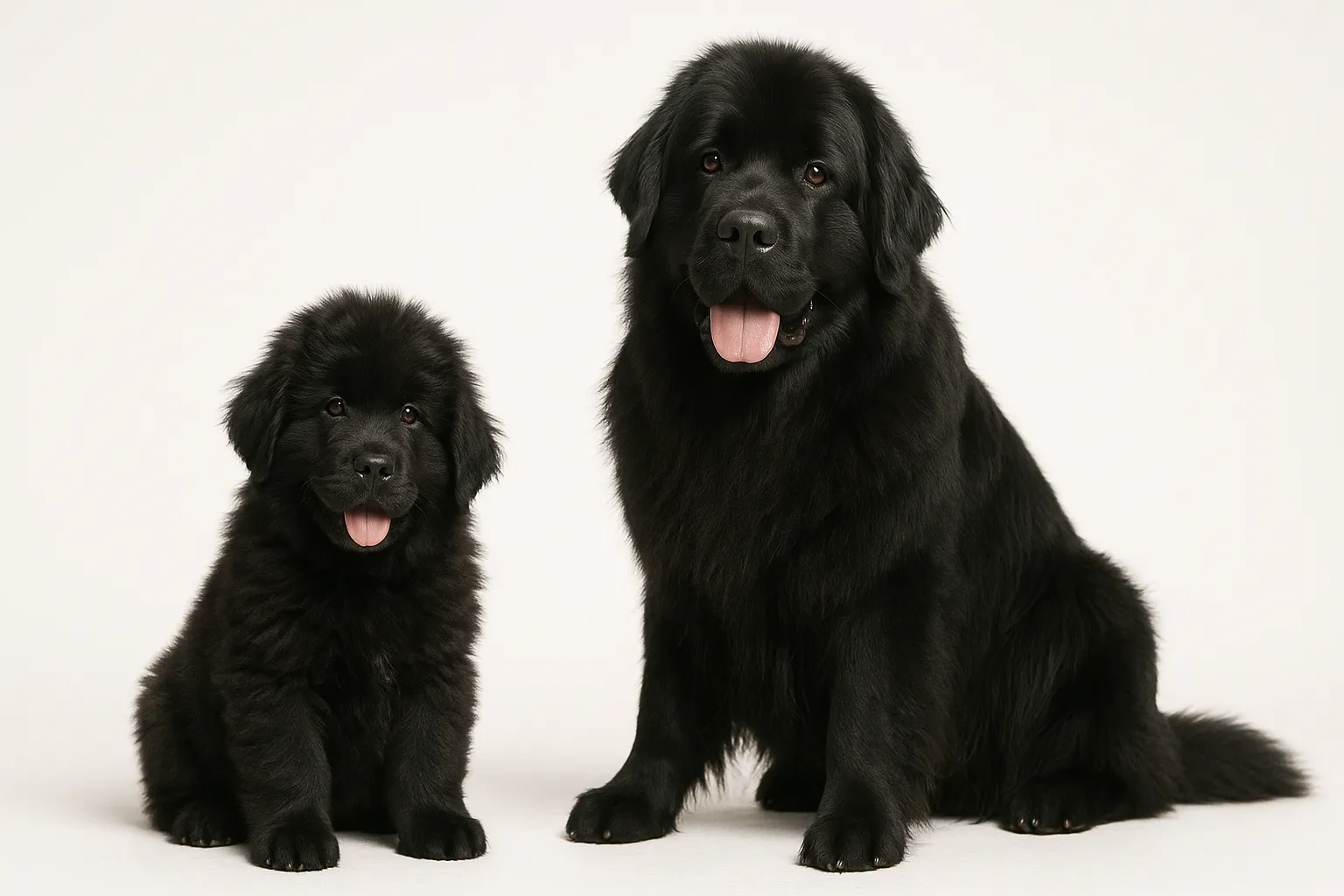
Eight to Ten Years With the Gentlest Giant You Will Ever Know
There is a cruel math to Newfoundland ownership. The dogs who bond most deeply, who lean against you with 130 pounds of quiet devotion, who would swim through riptides to reach a drowning stranger — they get the shortest time. Eight to ten years. Some reach eleven. Too many fall short of eight.
At 100 to 150 lbs, Newfoundlands pay the full biological penalty of giant-breed size: elevated IGF-1 accelerates cellular aging, massive joint loads compound structural wear from puppyhood, and cardiac disease develops earlier than in smaller dogs. The 2024 Scientific Reports lifespan analysis confirmed what every Newfoundland owner already feels: these dogs age on a compressed timeline [1][5].
That compression changes the prevention calculus. You cannot afford to wait and see with this breed. Every month of delayed screening or unchecked weight gain costs a larger share of the total lifespan. Early action is the only strategy that works.
Breed-Specific Risk Profile
Hip Dysplasia
Watch for bunny-hopping gait, rear stiffness, difficulty rising, or reduced drive to exercise. In Newfoundlands, lean growth management, controlled activity levels, and long-term mobility planning form the foundation of hip health [3][5].
Heart Disease
Watch for exercise intolerance, cough at rest or nighttime, increased sleeping respiratory rate, or fainting episodes. Routine cardiac monitoring and earlier diagnostic workup when symptoms emerge are the interventions that change outcomes [3][5].
Bloat (GDV)
Watch for retching without vomiting, distended abdomen, restlessness, and sudden weakness. Prophylactic gastropexy should be discussed with your veterinarian — this is a high-risk breed [3][5].
Arthritis
Watch for stiffness after rest, reduced stamina, slower transitions, and reluctance on stairs or jumps. Lean weight targets, low-impact conditioning, and early pain management preserve mobility and comfort [3][5].
Cancer
Watch for new or changing masses, unexplained weight loss, appetite decline, and persistent lethargy. Earlier lump checks and age-adjusted screening improve early-detection options in a breed where cancer is a leading cause of death [3][5].
Your Highest-Return Health Investments
The prevention actions most Newfoundland owners should prioritize above all else:
- Keep giant-breed body condition controlled from puppyhood
- Use early cardiac surveillance in adulthood
- Protect mobility with traction, ramps, and low-impact exercise
Long-run outcome quality in Newfoundlands is most responsive to three controllables: weight trend, mobility maintenance, and prevention timing [2][7][8].
Evidence-Based Longevity Priorities
Body Composition and Muscle Maintenance
The relationship between body condition and lifespan in Newfoundland dogs is direct: lean dogs live longer with fewer chronic diseases, and the data is unambiguous. In giant breeds, excess weight accelerates orthopedic decline and shortens lifespan more dramatically than in smaller dogs. Their working heritage — water rescue, draft work — means muscle maintenance directly affects functional longevity. The target is lean functional strength.
Condition-Focused Prevention Stack
Hip dysplasia, heart disease, bloat, and age-associated decline are the highest-yield clinical targets. Build prevention around early screening, fast treatment escalation, and disciplined adherence to long-term management plans.
Behavior, Stress Load, and Recovery
Daily routine consistency matters more in working breeds than in most other groups. Stable sleep windows, controlled activity, and clear social structure prevent stress-driven aging acceleration in Newfoundlands — dogs who are sensitive to household disruption despite their calm exterior.
Preventive Screening Cadence
Use planned veterinary reassessment intervals, then tighten cadence when trend logs show drift in orthopedic function or gait quality. Early intervention windows are where most healthspan gains are made.
Breed-Specific Research
Use these evidence deep dives to add mechanism-level context to your Newfoundland longevity plan:
- Loyal’s LOY-001 and LOY-002: FDA Progress, Clinical Data, and 2026: tracks the large/giant-dog drug pipeline relevant to giant breeds.
- Canine Size Lifespan Biology: explains the IGF-1 and body-size biology behind the compressed giant-breed timeline.
- Arthritis Pain Stack for Dogs: Mobility-First Framework: clarifies monitoring tradeoffs for this breed’s key risk pathways.
- Muscle and Mobility Longevity Protocol for Aging Dogs: helps prioritize earlier action when health markers begin to drift.
- Blood Pressure Monitoring in Dogs: The Silent Risk Most Owners Miss: supports a clearer screening cadence for high-impact risk pathways.
Use this reading set as pre-visit prep so your observations and your veterinarian’s decisions stay aligned.
From Genetic Data to Monitoring Decisions
Genetic testing in Newfoundlands should drive monitoring strategy, not replace it. Use results to tighten surveillance windows and calibrate intervention thresholds. Consider hip and elbow scoring (OFA or PennHIP) to quantify orthopedic risk and breed-specific cancer panel or tumor marker surveillance when available as part of the initial risk assessment.
- Match your genetic panel to your breed’s documented risks and build a monitoring playbook around the results. One-time testing without follow-through is just expensive curiosity.
- Start your monitoring plan with Hip Dysplasia and Heart Disease so every test outcome has a clear next step attached to it.
- The most important insights about your Newfoundland’s health emerge from longitudinal data, not isolated visits. Keep a continuous record that connects genetic results, lab findings, and what you observe at home.
- Genetic results mean different things at different ages. What looked like a low-risk finding at two years old may deserve closer monitoring by age seven when the clinical picture has changed.
Results without follow-through are noise. Results that change your screening schedule, your daily observations, or your intervention threshold — those are signal.
Breeding History & Health Implications
Newfoundlands were bred for water rescue, draft work, and protective companionship — powerful swimming, heavy loads, and unwavering loyalty. That history created a massive, thick-coated dog with structural demands that directly inform today’s health risks.
- The breed’s physical architecture creates joint and skeletal stress patterns that demand ongoing orthopedic monitoring.
- Breed heritage and population health data both point to Hip Dysplasia, Heart Disease, Bloat as the surveillance priorities that deserve the tightest monitoring cadence.
- When you see the same subtle finding twice — a slight limp, a missed meal, a slower recovery — treat it as a signal, not a coincidence. Tighten your monitoring before it compounds.
- Prevention strategies that never get updated become prevention rituals. Revisit yours regularly and adjust based on what the data actually shows.
Use breeding history to build the initial watchlist. Use your dog’s own health trends to decide when surveillance becomes intervention.
Monitoring Schedule by Life Stage
- Puppy to 2 years: tightly manage growth rate, traction, and joint load.
- 3 to 5 years: start midlife-style screening earlier than average-size breeds.
- 6+ years: maintain high-frequency monitoring for mobility, cardiac status, and whole-body resilience.
Longevity Outlook: Making Every Year Count
Newfoundland owners do not have the luxury of a long timeline. Every year of health you protect represents a larger fraction of your dog’s total life than it would for a breed that lives to 14 or 15. That reality should sharpen, not discourage.
The Newfoundlands who reach 10 and 11 with strong quality of life are not statistical flukes. They are the dogs whose owners started cardiac monitoring early, kept body condition lean through every growth phase, built bloat-readiness into the household routine, and acted on subtle mobility changes instead of waiting for obvious decline. Consistency across a compressed timeline is what separates a good outcome from a heartbreaking one.
Most-Missed Early Drift Pattern
Early disease progression in Newfoundlands usually presents as low-grade changes that owners attribute to normal aging:
- Subtle hind-limb stiffness after rest related to Hip Dysplasia that owners often dismiss as temporary
- Subtle compensation patterns that mask Heart Disease progression: reduced exercise tolerance attributed to aging
- Gradual drift toward Bloat signs that become harder to reverse: unproductive retching, rigid distended abdomen, and rapid deterioration
If baseline function is drifting for 7-10 days, treat it as a prevention failure signal and reassess early.
Giant-Breed Transfer and Mobility Safety Rule
As mobility changes, injury risk rises for both dog and owner during transfers.
- Use traction pathways and controlled rise-assist methods early, before crises force improvisation
- Avoid rushed stair/furniture transitions in fatigued or painful states
- Escalate sooner when sit-to-stand time and gait stability worsen together
Proactive transfer safety protects functional reserve and reduces avoidable falls.
Cardiac-GDV Dual-Risk Emergency Plan
Newfoundlands need one plan that covers both cardiopulmonary and abdominal emergencies:
- Define transport triggers for collapse, severe breathing effort, and unproductive retching
- Keep emergency contacts and route logistics visible for all caregivers
- Call ahead to ER during transit for faster triage handoff
Dual-risk planning reduces delay in two of the breed’s highest-impact emergency scenarios.
Heat and Exertion Throttle Rule
Newfoundlands carry high thermal load because of size and dense coat. Exertion decisions should be weather-gated, not just effort-gated:
- Scale session intensity by both temperature and humidity, not temperature alone
- Stop sessions when recovery panting remains prolonged beyond the dog’s baseline
- Prioritize short, frequent low-heat conditioning over sporadic long outings
- Treat heat-intolerance drift as a medical signal, not only a fitness issue
This throttle rule helps prevent cardiopulmonary strain and post-exertional setbacks in giant dogs.
Condition-Specific Monitoring Triggers
Know what to watch for and when to act. These are the breed-relevant triggers that matter most:
- Hip Dysplasia: Track post-exercise recovery: how long does stiffness last after a walk? If recovery time is lengthening month over month, schedule a reassessment.
- Heart Disease: Track exercise tolerance over time. If walks that used to be easy now produce heavy breathing, slowing, or sitting down mid-route, that pattern needs evaluation.
- Bloat (GDV): Track appetite, stool quality, and vomiting frequency; escalate for persistent GI signs or rapid weight change.
- Arthritis: Monitor stiffness duration after rest. Brief morning stiffness is common, but stiffness lasting beyond 15-20 minutes or worsening over weeks signals progression.
- Cancer: Watch for unexplained weight loss, persistent appetite changes, or energy decline that does not resolve. These nonspecific signs often precede more obvious cancer presentations.
12-Month Longevity Execution Plan
Use this quarterly framework to keep prevention proactive instead of reactive:
Quarter 1: Baseline and Risk Mapping
- Build your baseline data set — weight, body condition score, gait assessment, and a sleep and appetite log for the first two weeks
- Identify the conditions most likely to affect this breed and agree on specific screening milestones with your veterinarian
- Establish a single feeding protocol the whole household follows, including measured portions and a hard cap on daily treat calories
- Get baseline imaging and bloodwork for cancer screening, so any future findings can be compared against a known starting point
Quarter 2: Adherence and Early Drift Control
- Run a candid self-assessment: are you hitting the screening targets, feeding protocols, and exercise routines you set in Q1?
- When any measurement starts trending in the wrong direction, the correct response is more frequent monitoring, not waiting to see if it reverses
- Report emerging changes in appetite, stamina, respiratory patterns, mobility, or behavior to your veterinarian before they become established patterns
- Film a new gait video and compare side by side with Q1 footage — visual comparison catches changes you cannot see day to day
Quarter 3: Midyear Reassessment
- Use six months of accumulated data to determine which prevention investments are paying off and which need to change
- Refine your monitoring plan based on six months of evidence — what deserves more attention, what can stay on the current cadence?
- Adapt exercise type and intensity for the current season and your dog’s evolving physical capacity
- Repeat resting respiratory rate trending and cardiac auscultation if murmur or arrhythmia risk is present
Quarter 4: Senior-Readiness Update
- Set next year’s veterinary calendar based on what this year’s monitoring actually revealed, not what you expected to find
- Refine your escalation criteria based on what you learned about how this breed’s conditions present and progress
- Record your prevention priorities for the next cycle with specific dates, specific tests, and specific owner responsibilities
- Close the year with repeat imaging and bloodwork for cancer surveillance — compare against your Q1 baseline data
- Complete year-end orthopedic assessment and adjust exercise load for next year
When to Escalate Fast
Contact your veterinarian immediately if you observe any of these:
- Marked appetite suppression with visible lethargy or unwillingness to stand and move normally
- Acute breathing difficulty, loss of consciousness, or sudden onset of neurologic signs such as seizures or disorientation
- Multiple vomiting episodes in a short window, restlessness with abdominal discomfort, or a rigid or bloated abdomen
- A sudden drop in willingness to move, visible pain during normal activity, or marked behavioral change
- Unproductive retching, restlessness, and rigid abdomen (bloat emergency)
- Syncope episodes or resting respiratory rate consistently above your dog’s established baseline
Breed-Specific Priorities This Year
Direct your effort toward the actions with the highest longevity return for your Newfoundland. Schedule quarterly vet check-ins to recalibrate based on how your dog’s health trajectory is actually moving.
- Keep giant-breed body condition controlled from puppyhood
- Use early cardiac surveillance in adulthood
- Protect mobility with traction
Home Tracking Dashboard
Record these data points monthly — pattern recognition is the foundation of early intervention:
- Body weight and body-condition score documented side by side for trend comparison
- Appetite, water intake, and stool/urine pattern changes
- Respiratory rate at rest and after mild activity
- Exercise tolerance and recovery patterns
- Exercise stamina relative to their personal norm, plus recovery time and next-day stiffness
- Rest quality, emotional baseline, and social responsiveness — these soft markers often shift before hard data does
- Condition-specific early drift markers tied to hip dysplasia, heart disease, bloat
What and How to Feed
For Newfoundlands, nutrition works best when intake precision is tied to giant life-stage transitions. Use Feeding Guide for Giant Breeds as the baseline and add Omega-3 Fish Oil for Dogs only when endpoints are explicit and reassessment cadence is pre-defined.
The most consistent results come from strict treat accounting and rapid correction when weight or body-condition metrics shift.
Frequently Asked Questions
Why does growth-phase nutrition matter so much in Newfoundlands? Giant-breed puppies that grow too fast develop weaker bone structure and higher rates of hip and elbow dysplasia. Controlled growth — using a giant-breed puppy formula with appropriate calcium-to-phosphorus ratios — builds a stronger skeletal foundation that pays dividends for every subsequent year of life.
When should cardiac screening start for a Newfoundland? Earlier than most owners expect. Baseline echocardiography by age 2 to 3 establishes a reference point for tracking changes. Newfoundlands are prone to dilated cardiomyopathy and subvalvular aortic stenosis, both of which progress silently before symptoms appear.
How do I safely exercise a Newfoundland in warm weather? Scale intensity to temperature and humidity, not just to your dog’s apparent willingness. Short, frequent walks during cool parts of the day are safer than single long outings. Swimming is ideal — it provides conditioning with minimal joint impact and helps with thermoregulation. Stop immediately if recovery panting lasts beyond the dog’s established baseline.
Can supplements compensate for excess weight in a giant breed? No. In a 130-pound dog, each extra pound magnifies orthopedic and cardiac strain in ways that no supplement can offset. Weight management through measured feeding is the foundation. Supplements like omega-3 fatty acids or glucosamine can support a good weight-management plan, but they cannot replace it.
What is the most common preventable mistake in Newfoundland households? Allowing “normal for the breed” to excuse excess weight. Newfoundlands are supposed to be large and substantial, but that does not mean every Newfoundland at 150 lbs is at a healthy weight. Learn to assess body condition by touch — you should feel ribs without pressing hard, and there should be a visible waist from above.
References
[1] AKC Newfoundland Breed Information [2] Life expectancy, mortality, and longevity in companion dogs (Scientific Reports, 2024) [3] OFA CHIC Program [4] Dog Aging Project [5] AAHA Canine Life Stage Guidelines [6] Merck Veterinary Manual [7] WSAVA Global Nutrition Guidelines [8] Effects of Diet Restriction on Life Span and Age-Related Changes in Dogs (Kealy et al., 2002)
Related reads
Related Reading
Continue exploring