Evidence deep dives for Progressive Retinal Atrophy (PRA)
Pair mechanism-level evidence with practical protocol context before discussing next steps with your veterinarian.
The Dog That Navigates Home Perfectly but Freezes in New Rooms
Your dog starts bumping into furniture only after you rearrange the room. In familiar spaces, everything looks normal. That gap between competence in known environments and hesitation in new ones is often the first sign of progressive retinal atrophy.
PRA is a group of inherited retinal degenerations that gradually destroy photoreceptor function, leading to vision loss and, in many dogs, eventual blindness.
The condition is bilateral and progressive. There is no moment of acute crisis — just a slow fade that rewards owners who plan ahead.
Night vision typically deteriorates first, before daytime impairment becomes obvious. Dogs compensate remarkably well using memory, scent, and hearing, so families often underestimate how far vision has declined.
The gap between actual vision loss and noticeable behavior change can be months or longer.
Beyond Treatment: The Longevity Dimension
PRA does not usually shorten life directly. But it can quietly erode healthspan through injury risk, activity loss, stress reactivity, and caregiver-management friction.
A dog losing confidence may move less, gain weight, and disengage from enrichment — unless the household adapts early. Longevity-focused PRA management is about preserving function: safe movement, cognitive engagement, stable routines, and early support for anxiety or secondary behavior drift as vision declines.
Early Clinical Pattern and Home Monitoring
The earliest pattern is low-light performance drift. You will get more useful information by tracking behavior in predictable environments over weeks than by recalling isolated incidents.
- hesitation in dim hallways, on stairs, or during outdoor transitions at dusk
- bumping into furniture after room changes or clutter accumulation
- startle reactions when approached from the side or behind
- reduced willingness to jump into cars, onto couches, or down unfamiliar stairs
- increased dependence on owner proximity in new environments
- subtle nighttime anxiety or pacing in previously stable routines
Video clips recorded in consistent lighting can be more useful than memory when discussing progression with your veterinarian.
Diagnostic Workflow and Staging
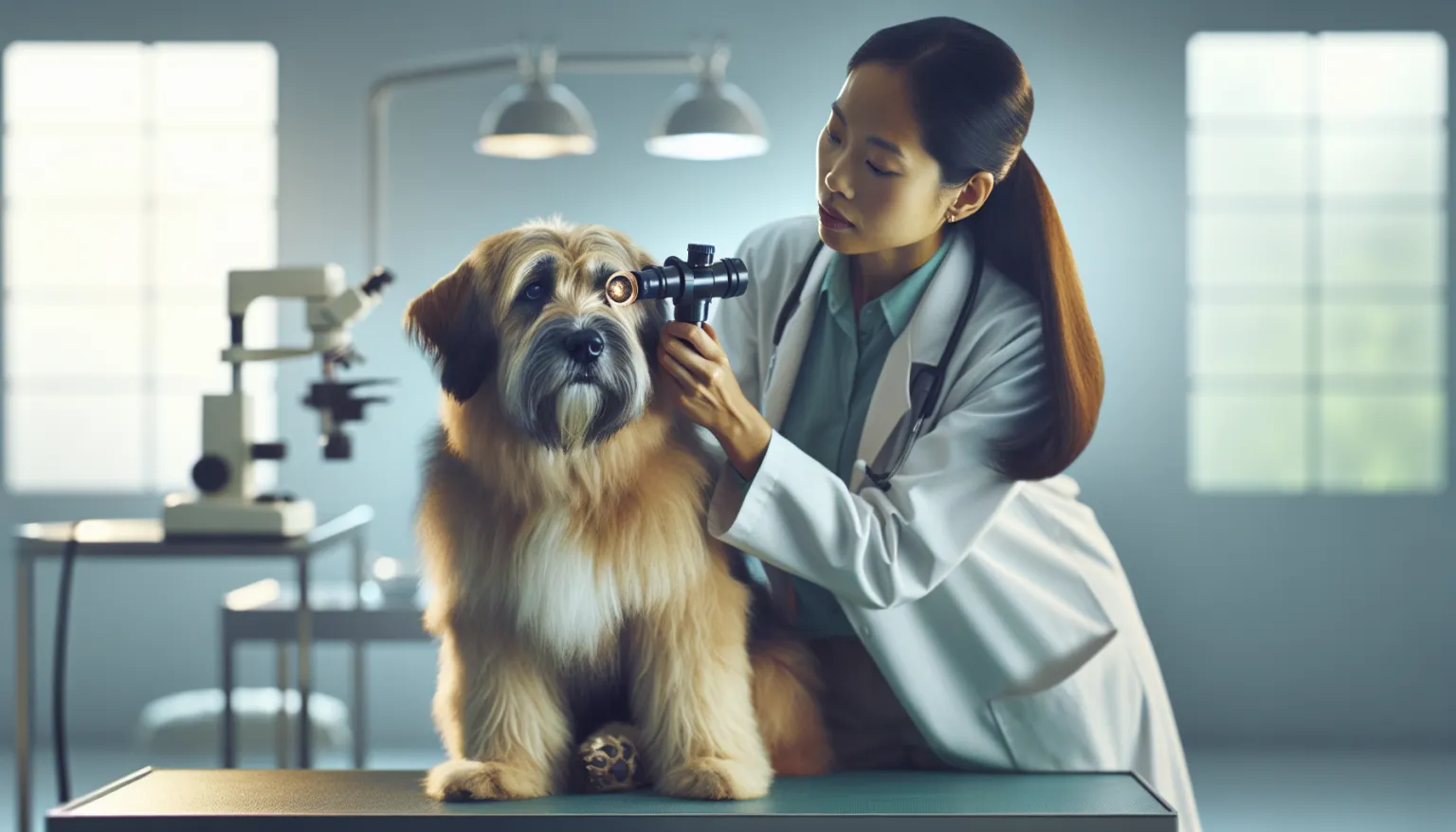
Veterinarians generally diagnose PRA by combining ophthalmic examination with tests that separate inherited retinal degeneration from other causes of visual decline, including cataracts, glaucoma, or neurologic disease. Breed and family history guide suspicion, but objective eye evaluation remains central.
Genetic testing can clarify inherited risk in many breeds and supports breeding decisions. Clinical monitoring still matters, though, because functional decline is what drives day-to-day safety planning.
- complete baseline ophthalmic exam when visual drift is first suspected
- reassess at the interval recommended by your veterinary ophthalmologist
- distinguish retinal degeneration from lens disease and pressure-related eye disease
- document household function changes alongside exam findings
Longevity Management Plan
No broadly curative therapy exists for most PRA forms in general practice. The practical objective is to keep your dog safe, confident, and engaged as vision changes over time.
Households that do this well share a few traits: they keep home layout stable, minimize hazard surprises, and intentionally preserve exercise and enrichment so mobility and cognition do not decline in parallel with vision.
- keep furniture pathways predictable and avoid frequent layout changes
- use tactile and verbal cue routines for doors, stairs, and feeding areas
- maintain daily controlled exercise to protect muscle and body condition
- pre-plan stress reduction for travel, boarding, and busy environments
Practical 12-Week Execution Framework
- Weeks 1-2 (baseline lock-in): confirm diagnosis, start one shared household log, and capture daily markers including function, appetite, elimination, activity tolerance, and sleep quality.
- Weeks 3-4 (adherence audit): review whether every caregiver follows the same approach. Identify missed-step friction and remove one reliability bottleneck causing drift.
- Weeks 5-6 (response checkpoint): compare current trends against baseline. Escalate quickly if core markers are not improving. Avoid changing multiple variables in the same week.
- Weeks 7-8 (risk tightening): predefine escalation thresholds for severe symptoms, confirm your after-hours emergency route, and align caregiver decisions so urgent signs are never handled with watch-and-wait.
- Weeks 9-10 (resilience build): reinforce exercise, mobility, and nutrition routines your veterinarian has cleared, converting short-term stabilization into durable function.
- Weeks 11-12 (handoff to maintenance): document the long-term reassessment cadence, decide which metrics must stay tracked weekly, and schedule the next checkpoint before current momentum fades.
Most-Missed Drift Pattern
Families tend to react only when signs become obvious. But PRA outcomes — measured in quality of life, not cure — improve when adaptation begins at the first measurable drift rather than after a serious fall or behavioral breakdown.
Missing that window means playing catch-up. The most common process failure is inconsistent household execution, where each caregiver follows a different version of the plan and trend data becomes unreliable. The second is making multiple simultaneous changes that obscure what actually helped.
Households that review one objective metric each week (such as navigation confidence or activity level) usually detect meaningful decline much earlier. Durable quality of life comes from reducing preventable variance in daily routines and adjusting promptly when thresholds are crossed.
Nutrition and Supportive Care Priorities
No supplement has proven ability to reverse PRA progression. But nutrition still supports broader resilience goals: stable weight, sustained activity, and conservative antioxidant strategy where appropriate.
Supplement decisions should prioritize safety and realistic expectations. The most reliable gains come from routine quality, environmental adaptation, and continuous physical and cognitive engagement.
- Feeding Guide for Senior Dogs: Healthspan Nutrition
- Omega-3 Fish Oil for Dogs: Evidence, Dosing Context, and Safety
- Vitamin E for Dogs: Evidence and Safety
- Blueberries for Dogs: Antioxidant Context and Limits
For evidence context and execution details, review:
- Senior Dog Screening Protocol
- Canine Cognitive Decline: Early Action Plan
- Home Biomarker Tracking for Senior Dogs
Veterinary Monitoring Timeline
Progression pace varies by subtype and breed. A predictable review cadence helps families adjust safety and activity plans before confidence drops sharply.
- initial phase: baseline ophthalmic assessment and household safety review
- follow-up phase: interval rechecks for progression and complication screening
- function phase: update mobility and enrichment plan as visual ability changes
- senior phase: monitor overlap between vision loss, cognition, and frailty signals
At each visit, ask which single home adaptation would most reduce injury and stress risk in the next 90 days.
When to Escalate Same Day
PRA progression itself is usually gradual, but certain eye findings require urgent same-day evaluation:
- sudden painful eye, squinting, or pronounced redness
- acute disorientation that is faster than expected PRA progression
- head tilt, collapse, or neurologic signs with vision changes
- sudden clouding plus discomfort suggesting pressure-related eye crisis
- new trauma from falls or collision during rapid confidence loss
Related Condition Pathways
Progressive retinal atrophy often overlaps with adjacent pathways that affect diagnosis timing, treatment options, and long-term resilience:
- Cataracts: lens opacity can coexist with or mimic elements of visual decline.
- Glaucoma: painful pressure disease needs urgent distinction from chronic retinal degeneration.
- Eye Conditions: broader eye-disease triage helps avoid delayed diagnosis.
- Cognitive Decline: sensory loss and cognitive aging often interact in senior dogs.
Use this information to ask better questions and understand your options. All diagnosis confirmation and treatment adjustments should go through your veterinarian.
Related Breed Longevity Guides
These breeds are frequently discussed in PRA screening and owner-education pathways:
- Miniature Poodle Lifespan & Longevity Guide
- Toy Poodle Lifespan & Longevity Guide
- Papillon Lifespan & Longevity Guide
- Cocker Spaniel Lifespan & Longevity Guide
- Labrador Retriever Lifespan & Longevity Guide
Breed-level risk should drive proactive screening and adaptation planning, not fatalism.
Frequently Asked Questions
Can PRA be cured in dogs?
Most forms of PRA currently have no broadly available cure in routine veterinary practice. The photoreceptor degeneration is progressive and irreversible with current therapies. Gene therapy research has shown promise in specific PRA subtypes in laboratory settings, but these treatments are not yet widely accessible. Management focuses on preserving function, safety, and quality of life for as long as possible through environmental adaptation and structured monitoring.
Is PRA painful?
PRA itself is usually not painful — the retinal degeneration does not cause discomfort. However, dogs with PRA are at elevated risk for secondary cataracts, and coexisting conditions like glaucoma can cause significant eye pain. Any signs of eye discomfort — squinting, redness, pawing at the face, or sudden behavioral change — warrant urgent evaluation to rule out a painful condition that needs separate treatment.
Why does my dog seem normal in familiar rooms?
Dogs compensate exceptionally well using spatial memory, scent mapping, hearing, and whisker feedback. In a home layout they have memorized, they can navigate with remarkable confidence even with substantially reduced vision. This adaptation is why PRA often goes undetected until the owner rearranges furniture, moves to a new home, or notices hesitation in unfamiliar environments. The gap between familiar-space competence and novel-space difficulty is itself a diagnostic clue.
Should I stop walks after PRA diagnosis?
No. Controlled exercise remains important for maintaining muscle condition, cardiovascular health, and mental engagement. Rather than reducing activity, adapt the routine: keep walking routes consistent and predictable, use verbal cues approaching curbs and turns, and avoid off-leash activity in unfamiliar areas. Dogs with PRA benefit from continued movement and outdoor stimulation, provided the environment is managed for safety.
Does genetic testing replace eye exams?
No. Genetic testing and ophthalmic examinations serve different purposes and complement each other. Genetic results identify inherited risk alleles and inform breeding decisions — they tell you whether a dog carries a mutation, not whether clinical disease has started or how fast it is progressing. Regular eye exams by a veterinary ophthalmologist track actual retinal status and functional changes, which drives day-to-day safety planning and home adaptation timing.
Medical Disclaimer
This article is educational and not a substitute for veterinary diagnosis or treatment. Dogs with sudden eye pain, rapid disorientation, or neurologic signs need immediate in-person veterinary evaluation.
References
- American College of Veterinary Ophthalmologists (ACVO) guidance on inherited retinal disease in dogs.
- Veterinary ophthalmology literature on PRA progression, diagnosis, and differential workup.
- Evidence on sensory decline, mobility confidence, and quality-of-life adaptation in aging dogs.
- Canine genetics resources describing breed-associated retinal degeneration risk patterns.
- Clinical consensus on multimodal home-safety adaptation for progressive vision loss.
Related reads
Related Reading
Continue exploring