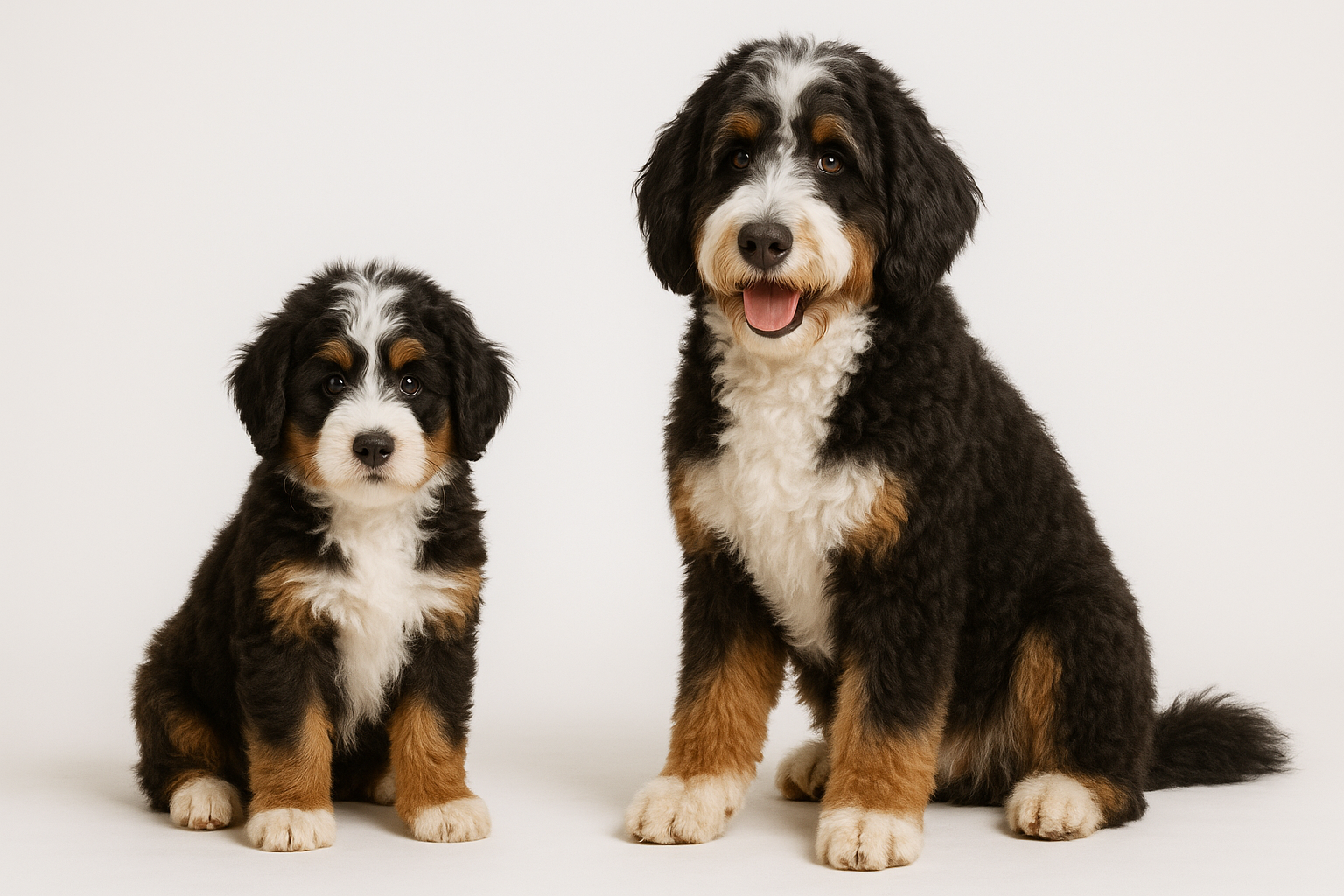
A Cross Designed to Buy Time
The Bernedoodle exists, in large part, because people fell in love with a breed that does not live long enough. The Bernese Mountain Dog averages just 7-10 years — one of the shortest lifespans among popular breeds — driven by an extraordinarily high cancer rate and the biological costs of giant-breed growth. Crossing with a Standard Poodle was an attempt to extend that timeline while preserving the Bernese temperament: calm, affectionate, deeply loyal.
The strategy has some scientific basis. First-generation Bernedoodle crosses often live 12-15 years, a meaningful extension over the Bernese parent. But understanding why — and where the limits are — matters for how you manage your dog’s health.
What Hybrid Vigor Actually Delivers
A 2013 study in the Journal of the American Veterinary Medical Association examined over 27,000 dogs and found purebreds were significantly more likely to develop 10 of 24 genetic disorders compared to mixed breeds. For conditions driven by simple recessive inheritance, first-generation crosses between genetically diverse parents can see real benefit.
The catch: the conditions most threatening to Bernese Mountain Dogs — cancer, hip dysplasia, and arthritis — are polygenic. They are influenced by many genes and by environment. Hybrid vigor does not eliminate them. It may reduce severity or delay onset, but it does not make a Bernedoodle immune to its Bernese heritage.
Multigenerational Bernedoodle breeding (F1B, F2) progressively reduces heterosis advantage. If your Bernedoodle comes from generations of Bernedoodle-to-Bernedoodle or Bernedoodle-to-Poodle crosses, the genetic diversity that drives hybrid vigor narrows.
The Bernese Mountain Dog Inheritance
The Bernese side contributes the traits people love — the tricolor coat, the gentle giant temperament, the desire to be physically close to their humans at all times. It also contributes a medical profile that demands proactive management.
Cancer is the primary concern. Histiocytic sarcoma alone claims a disproportionate number of Bernese Mountain Dogs, and the breed’s overall cancer mortality rate significantly exceeds the all-breed average. Your Bernedoodle carries some fraction of this genetic predisposition. How much depends on the specific parents and generational distance from purebred Bernese lines.
Hip dysplasia and elbow dysplasia are both common in the Bernese, with OFA data showing prevalence rates well above the all-breed average. These conditions create cascading joint degeneration that progresses to arthritis — a primary driver of mobility loss and quality-of-life decline in aging dogs.
Bloat (GDV) is a risk in any deep-chested large breed. Bernedoodles in the 70-90 lb range with deeper chest conformations should be treated as bloat-risk dogs, with appropriate feeding strategies and a household emergency plan.
The Poodle Contribution
The Poodle side delivers longevity, intelligence, and coat characteristics. Standard Poodles average 12-15 years — a substantial improvement over the Bernese timeline. This is where most of the Bernedoodle’s lifespan extension originates.
Poodles bring their own genetic concerns. Progressive retinal atrophy (PRA) is well-documented in Poodle lines. Responsible breeders test for prcd-PRA before breeding. Skin allergies and sebaceous adenitis are Poodle-origin conditions that can affect Bernedoodles with heavier Poodle coat influence.
The Poodle coat genetics also create grooming demands that directly affect health. A Bernedoodle coat that is not regularly brushed and groomed traps moisture, harbors bacteria, and creates conditions for chronic skin inflammation.
Where the Biggest Longevity Gains Live
Cancer: Start Surveillance Early
Given the Bernese Mountain Dog’s cancer burden, treat your Bernedoodle as a higher-risk dog for malignancy — even though the Poodle cross likely reduces absolute risk compared to a purebred Bernese. Practical steps:
- Monthly at-home mass checks starting at age 4-5 (earlier than typical large-breed recommendations)
- Annual wellness bloodwork with attention to unexplained changes in white blood cell counts or organ values
- Discuss abdominal ultrasound with your vet starting at age 5-6
- Rapid follow-up on any new lump that grows, changes texture, or becomes fixed to underlying tissue
Do not assume the Poodle cross eliminates cancer risk. Assume it reduces it, and screen accordingly.
Joint Protection Is a Lifelong Project
Both parent breeds carry significant orthopedic disease risk. In a Bernedoodle weighing 50-90 lbs, the combination of genetic predisposition and mechanical load makes joint health a central longevity concern.
The Purina Lifetime Study demonstrated that lean dogs developed arthritis four years later than their overweight counterparts — an enormous margin in a breed averaging 12-15 years. Controlled puppyhood growth, lifelong weight management, and joint-appropriate exercise are the highest-return interventions available.
OFA or PennHIP hip and elbow evaluations provide baseline data. Even if your dog is asymptomatic, knowing the joint conformation helps calibrate exercise intensity and guides when to introduce joint-support interventions.
Bloat Awareness and Prevention
Large Bernedoodles with deep chest conformation carry meaningful bloat risk. Preventive measures include:
- Feeding two or three smaller meals rather than one large meal
- Avoiding vigorous exercise immediately before and after eating
- Discussing prophylactic gastropexy with your vet, particularly if your Bernedoodle has a narrow, deep chest
- Knowing your nearest 24/7 emergency veterinary hospital before you need it
The symptoms — unproductive retching, abdominal distension, restlessness, and rapid decline — can progress to life-threatening within hours.
Skin and Coat Health as Prevention
Bernedoodle coats vary enormously, from flat and shedding (more Bernese-like) to tight curls (more Poodle-like), with wavy coats falling between. Every coat type requires regular grooming, but curly and wavy coats are particularly prone to matting.
Matting is not a cosmetic problem. It traps moisture against the skin, creates bacterial and fungal reservoirs, and masks developing skin lesions. Dogs with skin allergies — common in this cross — suffer worse outcomes when coat maintenance is inconsistent.
Minimum grooming cadence: thorough brushing 3-4 times weekly, ear cleaning weekly (Poodle-inherited ear canal hair traps debris), and professional grooming every 6-8 weeks.
Nutrition for a Cross-Breed Body
Bernedoodles need nutrition calibrated to their size, growth phase, and risk profile. During puppyhood, controlled growth rate protects developing joints — avoid overfeeding or supplementing with extra calcium.
For adults, use Feeding Guide for Large Breeds as the baseline framework. Target a body condition score of 4-5 on the 9-point scale. The Bernese side often contributes a hearty appetite, and the combination of large frame and food motivation makes overfeeding deceptively easy.
Anti-inflammatory nutrition supports both joint and skin health. Omega-3 Fish Oil for Dogs provides EPA and DHA that modulate inflammatory pathways relevant to both arthritis and skin allergies. For dogs with documented joint concerns, discuss Glucosamine and Chondroitin for Dogs with your vet as a targeted adjunct.
Exercise That Builds Without Breaking
Bernedoodles are moderately active dogs that benefit from 45-75 minutes of daily exercise. Swimming is the gold-standard activity: cardiovascular conditioning with near-zero joint impact. Many Bernedoodles inherit water affinity from both parent lines.
During the first 18 months, limit high-impact activity. No sustained running on hard surfaces, no repetitive jumping, no forced exercise on growing joints. Instead, use varied terrain walking, supervised free play, and progressive conditioning.
For adult dogs, mix walking, swimming, hiking, and mental enrichment. Monitor post-exercise recovery: if your dog takes significantly longer to recover from a walk than it did six months ago, that is a signal worth investigating.
Preventive Screening by Life Stage
- Puppy to 18 months: Growth-rate control, joint-safe exercise, baseline hip/elbow evaluation, coat care establishment
- 2 to 4 years: Annual wellness exams, cardiac auscultation, eye screening for PRA, skin and ear health monitoring
- 5 to 8 years: Add cancer surveillance — annual abdominal ultrasound, comprehensive bloodwork. Begin monitoring for arthritis progression. Discuss senior screening timeline.
- 9+ years: Twice-yearly exams with senior bloodwork, mobility assessment, cardiac evaluation, and cancer surveillance
Breed-Specific Research
These deep dives provide evidence-based context for your Bernedoodle’s prevention plan:
- Arthritis Pain Stack for Dogs: Mobility-First Framework: joint-protective conditioning and orthopedic screening protocols.
- Blood Pressure Monitoring in Dogs: The Silent Risk Most Owners Miss: cardiac screening and early detection strategies.
- Senior Dog Screening Protocol: What to Test and When: structured screening framework for midlife and beyond.
Condition-Specific Monitoring Triggers
Know when observation should become action:
- Hip Dysplasia: Bunny-hopping gait, difficulty rising, reluctance to climb, or shifting weight off one leg.
- Elbow Dysplasia: Front-limb lameness, head bob when walking, stiffness after rest, or turning a forelimb outward.
- Cancer: New lumps that grow or change, unexplained weight loss, appetite decline with lethargy, sudden weakness or collapse.
- Arthritis: Gradual decline in activity enthusiasm, slower transitions (sit-to-stand, lying down), morning stiffness that improves with movement.
- Bloat: Unproductive retching, rapid abdominal distension, restlessness with signs of discomfort, drooling. This is always an emergency.
- Progressive Retinal Atrophy: Reluctance in dim lighting, dilated pupils, bumping into objects in unfamiliar spaces.
- Skin Allergies: Persistent scratching, paw licking, face rubbing, recurrent hot spots, or chronic ear inflammation despite routine cleaning.
12-Month Longevity Execution Plan
Quarter 1: Baseline and Risk Assessment
- Record starting weight, body condition score, and gait video
- Map parent breed health history with your vet and agree on priority screening targets
- Establish consistent feeding: measured meals, one feeder, treats within 10% of daily calories
- Complete baseline bloodwork, hip/elbow evaluation, and cardiac exam
Quarter 2: Protocol Adherence
- Audit compliance with Q1 plan — identify and close gaps before they compound
- Update weight, gait video, and skin/coat condition against Q1 baselines
- Address any emerging issues: ear infections, skin changes, appetite shifts
- Complete any outstanding genetic or eye testing
Quarter 3: Midyear Review
- Evaluate whether prevention strategies are producing measurable results
- Adjust exercise volume and type for seasonal changes and your dog’s current capacity
- Repeat cardiac auscultation if any previous concern
- Reassess grooming protocol and skin health status
Quarter 4: Planning for Next Year
- Synthesize full-year data into next year’s screening schedule
- Complete senior bloodwork and abdominal imaging if age-appropriate
- Run year-end mobility assessment and update exercise guidelines
- Refine your escalation criteria based on observed trends
When to Seek Emergency Care
These signs require immediate veterinary evaluation:
- Unproductive retching with abdominal distension or restlessness (bloat emergency)
- Sudden weakness, pale gums, or collapse (possible hemangiosarcoma or internal bleeding)
- Respiratory distress or sustained resting respiratory rate above 40 breaths per minute
- Complete food refusal lasting more than 24 hours with concurrent lethargy
- Sudden inability to bear weight or visible distress during movement
- Any loss of consciousness, even momentary
Home Tracking Dashboard
Monitor these indicators monthly:
- Weight and body condition score with hands-on rib palpation
- Appetite trends, water intake, stool quality
- Skin condition, coat quality, ear health
- Gait quality and exercise recovery time
- New masses — measure, photograph, date each discovery
- Energy level and engagement with family and activities
- Sleep quality and behavioral consistency
Frequently Asked Questions
Do Bernedoodles really live longer than Bernese Mountain Dogs? First-generation Bernedoodle crosses typically live 12-15 years compared to the Bernese average of 7-10 years. This extension comes primarily from Poodle genetics and heterosis effects. However, multigenerational Bernedoodles (F1B, F2+) progressively lose heterosis advantage.
Should I worry about cancer in a Bernedoodle? Yes, but to a calibrated degree. The Bernese Mountain Dog has one of the highest cancer rates among all breeds. While the Poodle cross likely reduces absolute risk, your Bernedoodle should still receive earlier-than-average cancer surveillance — starting mass checks by age 4-5 and discussing ultrasound screening by age 5-6.
How important is the breeder’s health testing? Critical. A Bernedoodle from parents tested for hip dysplasia, elbow dysplasia, PRA, and cardiac conditions starts with meaningfully better odds than one from untested parents. Ask for OFA, PennHIP, or CERF documentation.
Is bloat a real risk for Bernedoodles? For standard-size Bernedoodles (60-90 lbs) with deeper chest conformation, yes. Discuss prophylactic gastropexy with your vet, feed multiple smaller meals, and have an emergency plan in place. Miniature Bernedoodles carry lower risk.
What is the most impactful daily habit for Bernedoodle longevity? Maintaining lean body condition through measured feeding and consistent exercise. This single discipline reduces risk across cancer, joint disease, and cardiovascular health — the three domains most likely to limit your Bernedoodle’s lifespan.
How often should a Bernedoodle be groomed? Thorough brushing 3-4 times weekly, ear cleaning weekly, and professional grooming every 6-8 weeks. This is medical prevention, not cosmetic maintenance — matted coats and debris-filled ears drive chronic inflammation and infection.
Can I exercise my Bernedoodle puppy normally? Limit high-impact activity during the first 18 months while joints are developing. Avoid sustained running on hard surfaces, repetitive jumping, and forced exercise. Prioritize varied terrain walking, free play, and swimming as joint-safe alternatives.
References
[1] Prevalence of inherited disorders among mixed-breed and purebred dogs (Bellumori et al., JAVMA, 2013) [2] AKC Bernese Mountain Dog Breed Information [3] Effects of Diet Restriction on Life Span and Age-Related Changes in Dogs (Kealy et al., 2002) [4] Life expectancy, mortality, and longevity in companion dogs (Scientific Reports, 2024) [5] Orthopedic Foundation for Animals (OFA) [6] Merck Veterinary Manual [7] AAHA Canine Life Stage Guidelines
This content is for informational purposes only and does not constitute veterinary advice. Always consult a licensed veterinarian for decisions about your dog’s health, diagnosis, and treatment.
Related reads
Related Reading
Continue exploring