Evidence deep dives for Hip Dysplasia
Pair mechanism-level evidence with practical protocol context before discussing next steps with your veterinarian.
A Joint That Never Formed Right — and Why It Matters
Your large-breed puppy runs with a bunny-hop. A young German Shepherd sits with one leg kicked out to the side. A two-year-old Golden Retriever comes up limping after every play session at the park.
These may look like quirks. They are warning signs.
Hip dysplasia is a developmental orthopedic condition where the ball-and-socket joint of the hip forms abnormally. The femoral head and acetabulum fail to fit together smoothly, creating joint laxity and instability from the start.
This malformation sets off a cascade. Abnormal wear patterns grind down cartilage and bone. Instability drives inflammation and cartilage degradation. What begins as subtle lameness in a young dog can progress to chronic pain and severe mobility limitation by middle age.
Genetics drive the primary risk, but environment during growth plays a decisive role in whether a predisposed dog develops clinical disease and how severe it becomes. That distinction matters — because it means prevention is possible even in genetically susceptible dogs.
The Downstream Impact on Lifespan and Quality of Life
Hip dysplasia ranks among the most consequential orthopedic conditions in large and giant breed dogs. According to the Orthopedic Foundation for Animals (OFA), approximately 20% of German Shepherds, 19% of Golden Retrievers, and 12% of Labrador Retrievers evaluated show evidence of dysplasia.
The downstream effects compound. Chronic pain reduces activity levels, which accelerates muscle loss and weight gain. Reduced mobility worsens other age-related conditions, including obesity, cardiovascular deconditioning, and cognitive decline.
Dogs with untreated hip dysplasia often become sedentary years earlier than they should. A 2013 study in the Journal of the American Veterinary Medical Association found that dogs with severe hip dysplasia showed significantly reduced activity levels and increased pain scores compared to dogs with normal hips, even when controlled for age and weight.
For the owner watching this unfold, the hardest part is recognizing that the slow decline is not inevitable. It is treatable.
Which Breeds Carry the Highest Risk
Hip dysplasia can occur in any breed, but large and giant breeds carry the highest prevalence. Rapid growth rates, genetic predisposition, and biomechanical stress on developing joints all contribute.
High-Risk Breeds (OFA Data)
Based on OFA evaluations of over 1 million dogs:
- Saint Bernard: 47.7% prevalence (highest among common breeds)
- Newfoundland: 27.8% prevalence
- Rottweiler: 20.3% prevalence
- German Shepherd: 20.0% prevalence
- Golden Retriever: 19.2% prevalence
- Bernese Mountain Dog: 14.8% prevalence
- Labrador Retriever: 12.2% prevalence
Breeds With Lower Risk
Smaller breeds and certain working breeds show significantly lower rates:
- Border Collie: 4.3% prevalence
- Australian Cattle Dog: 4.6% prevalence
- Greyhound: 3.4% prevalence
The genetic architecture varies by breed. Some carry multiple risk alleles that compound, while others have protective variants that reduce susceptibility even with other risk factors present.
How Hip Dysplasia Develops — and What You Can Control
This is a multifactorial condition shaped by genetics, growth rate, nutrition, and exercise patterns. Understanding the balance between what is inherited and what is modifiable gives you leverage.
The Genetic Component
Hip dysplasia is polygenic — meaning many genes contribute. Research has identified over 20 genetic loci associated with canine hip dysplasia, but no single gene mutation accounts for the majority of cases.
Heritability estimates range from 0.2 to 0.6 depending on breed. That means 20-60% of hip dysplasia risk is genetic. It also means 40-80% of the risk is modifiable through environment and management. This is where owner decisions matter.
Responsible breeders use OFA or PennHIP screening to identify dogs with good hip conformation and selectively breed only those with favorable evaluations. Over generations, this measurably reduces population-level dysplasia rates.
Environmental Factors During Growth That Change Outcomes
Modifiable factors during the growth phase (birth to 12-18 months) have substantial impact:
Overnutrition and rapid growth: Puppies pushed for maximum growth rate develop hip dysplasia more frequently than those kept at lean body condition. A landmark study by Kealy et al. demonstrated that Labrador Retrievers fed 25% less food during growth had 50% lower rates of hip dysplasia compared to free-fed controls. That single finding should change how every large-breed puppy owner approaches feeding.
Excess body weight: Even modest overweight during puppyhood increases joint load and mechanical stress. Each additional pound multiplies force through the hip during movement.
High-impact exercise during growth: Repetitive jumping, stair climbing, and running on hard surfaces before skeletal maturity can worsen hip joint laxity. Growth plates close between 12-18 months depending on breed size, and until then, controlled exercise protects developing joints.
Calcium over-supplementation: Excess dietary calcium during growth (especially in large breed puppies) has been associated with increased skeletal abnormalities. Modern large-breed puppy formulas are balanced to avoid this.
The Warning Signs at Every Life Stage
Symptoms vary by age, severity, and the degree of osteoarthritis present.
In Puppies and Young Dogs (4-12 months)
- Bunny-hopping gait when running
- Decreased activity or reluctance to play compared to littermates
- Difficulty rising from a lying position
- Reluctance to jump or climb stairs
- Hind limb lameness after exercise
- Narrow stance in the rear legs
- Decreased range of motion in the hip joints
In Adult and Senior Dogs
As osteoarthritis progresses on top of the structural abnormality, symptoms become more persistent:
- Stiffness, especially after rest or in the morning
- Difficulty rising or lying down
- Decreased willingness to run, jump, or climb
- Audible clicking or grinding in the hip joints
- Muscle atrophy in the hind limbs
- Pain when the hip is manipulated
- Behavioral changes: irritability, withdrawal from activity
Many dogs adapt their gait to minimize pain, shifting more weight to their front limbs. Over time, this compensation can create secondary problems in the shoulders and elbows.
Getting an Accurate Diagnosis
Physical Examination
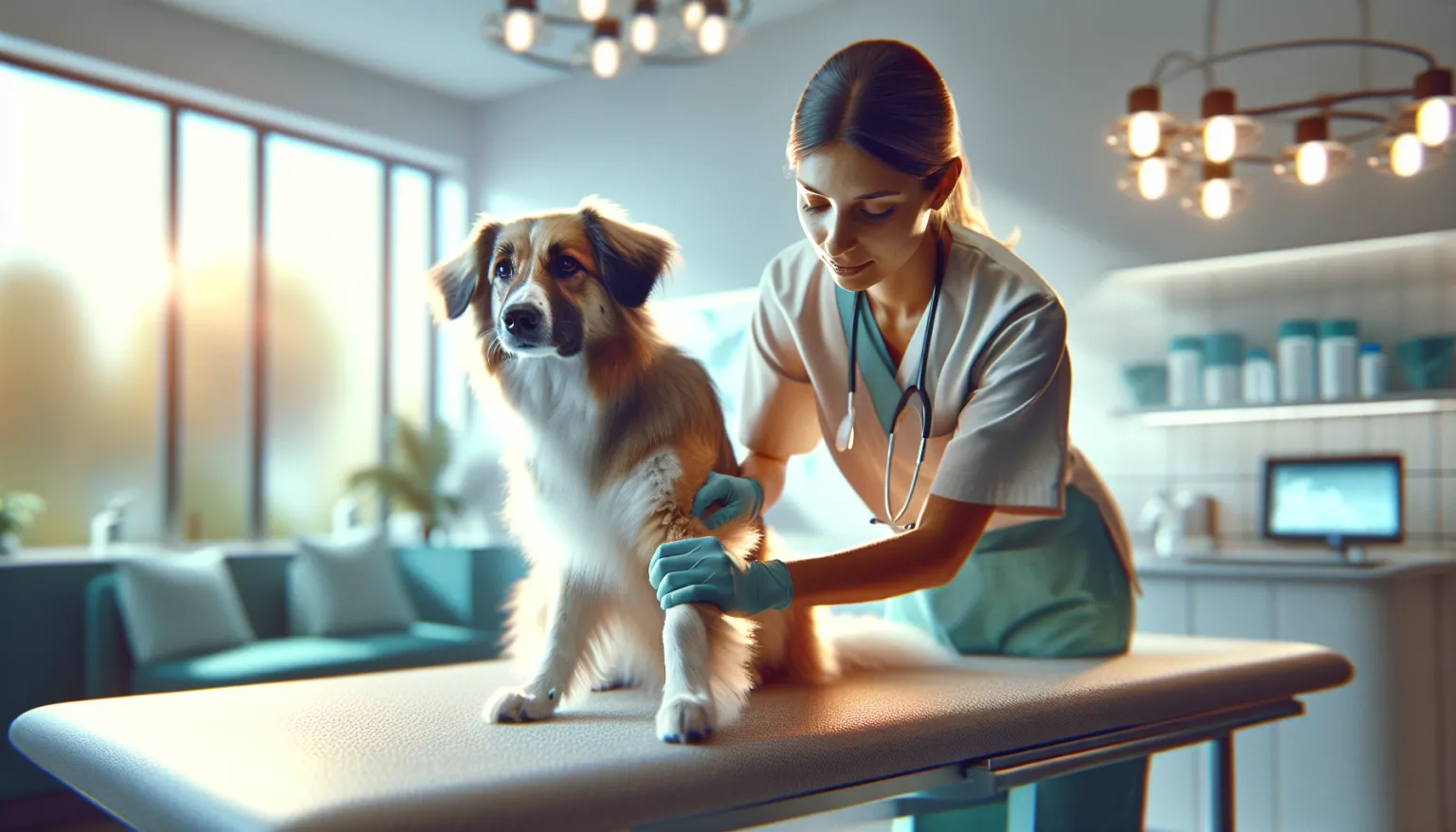
Veterinarians assess hip joint laxity using the Ortolani test, which detects abnormal movement of the femoral head in and out of the acetabulum. A positive Ortolani sign indicates laxity and suggests dysplasia risk.
Palpation may reveal pain, reduced range of motion, crepitus, or muscle atrophy. However, physical exam findings do not always correlate with radiographic severity, especially in young dogs.
Radiographic Evaluation: The Gold Standard
Hip radiographs confirm the diagnosis. Two primary evaluation methods exist:
OFA (Orthopedic Foundation for Animals): Dogs must be at least 24 months old. Board-certified veterinary radiologists assign a grade: Excellent, Good, Fair (all considered normal), Borderline, Mild, Moderate, or Severe dysplasia.
PennHIP: Can be performed as early as 16 weeks. Measures passive hip laxity using a distraction index (DI) score. Lower DI scores indicate tighter hips with less dysplasia risk. PennHIP is more predictive of future osteoarthritis development than OFA in young dogs — and that early information opens treatment options that close later.
Advanced Imaging
CT or MRI may be used for complex cases or surgical planning, but radiographs suffice for most diagnostic and breeding decisions.
Prevention Strategies That Have Real Evidence
Hip dysplasia cannot be entirely prevented in genetically susceptible dogs. But environmental management during growth dramatically reduces clinical disease severity.
Breeding Selection
The single most effective prevention strategy is breeding only dogs with excellent hip scores. Breeds with strong OFA/PennHIP screening programs show measurable reductions in dysplasia rates over time.
If purchasing a puppy from a breeder, request OFA or PennHIP certifications for both parents. Responsible breeders provide these without hesitation. Breeders who refuse or dismiss the question are telling you something.
Controlled Growth: Healthy, Not Fast
Feed large and giant breed puppies to grow at a controlled, steady pace rather than maximum speed:
- Use large-breed puppy formulas with appropriate calcium:phosphorus ratios
- Avoid free-feeding; use measured meals
- Keep puppies lean with ribs easily palpable but not visible
- Avoid overfeeding or supplementing beyond a complete diet
- Monitor body condition score monthly
The goal is healthy growth. Not fast growth. Not maximum size.
Protecting Developing Joints
Before 12-18 months of age (varies by breed):
- Avoid: Repetitive jumping (agility, dock diving, disc catching), running on concrete, long-distance running, rough play with much larger dogs
- Encourage: Swimming, controlled leash walks, gentle play on soft surfaces, mental enrichment activities, basic obedience training
After skeletal maturity, gradually increase exercise intensity while maintaining lean body condition.
Lifelong Weight Management
Keeping weight optimal is one of the highest-impact interventions for dogs with hip dysplasia. The Purina Lifetime Study demonstrated that Labrador Retrievers kept at lean weight throughout life had 50% less severe osteoarthritis than overweight controls.
Even a 10% reduction in excess body weight produces clinically meaningful improvements in mobility and pain.
Treatment: From Conservative Care to Joint Replacement
Treatment depends on the dog’s age, dysplasia severity, degree of osteoarthritis, activity level, and owner goals.
Conservative Management
Most dogs with mild to moderate hip dysplasia can be managed well without surgery:
Weight control: The foundation of every treatment plan. Excess weight accelerates cartilage breakdown and increases pain. No medication or supplement compensates for an overweight body.
Physical rehabilitation: Controlled exercise, hydrotherapy, therapeutic ultrasound, laser therapy, and range-of-motion exercises maintain muscle mass and joint mobility. Studies show rehab significantly improves function in dogs with hip dysplasia.
Pain management: NSAIDs (carprofen, meloxicam, deracoxib) reduce inflammation and pain. Long-term use requires periodic bloodwork to monitor liver and kidney function. Gabapentin or amantadine may be added for chronic pain that does not respond fully to NSAIDs alone.
Adequan (Polysulfated Glycosaminoglycan): An injectable disease-modifying osteoarthritis drug that may slow cartilage degradation. Evidence is mixed, but some dogs show meaningful improvement.
Joint supplements: Glucosamine, chondroitin, MSM, and omega-3 fatty acids are commonly used. Fish oil (EPA/DHA) has the strongest anti-inflammatory evidence at doses of 50-100 mg combined EPA/DHA per kg body weight daily.
Surgical Options
Juvenile pubic symphysiodesis (JPS): Performed in puppies under 20 weeks with early dysplasia signs. Fuses part of the pelvis to alter hip joint development. Requires very early diagnosis — which is why PennHIP screening at 16 weeks can be so valuable.
Triple pelvic osteotomy (TPO): For young dogs (under 10 months) with hip laxity but minimal arthritis. Repositions the acetabulum for better femoral head coverage. Success depends on minimal existing arthritis.
Femoral head ostectomy (FHO): Removes the femoral head, creating a “false joint” from scar tissue. Effective for small to medium dogs under 50 lbs. Larger dogs may not regain full function, but the procedure eliminates bone-on-bone pain.
Total hip replacement (THR): The gold standard for severe dysplasia with advanced arthritis. Replaces the entire joint with prosthetic components. Success rates exceed 90% in experienced hands, and dogs typically regain excellent function. Cost ranges from $3,500-$7,000 per hip.
Surgical decisions should be made in consultation with a board-certified veterinary surgeon (ACVS) based on the individual dog’s anatomy, age, activity level, and severity.
Supplement Evidence: An Honest Assessment
Joint supplements are widely used, but evidence quality varies considerably.
Glucosamine and chondroitin: Moderate evidence suggests potential benefits for osteoarthritis. A 2007 systematic review found some studies showed improvement in lameness and function, but results were inconsistent. Quality and bioavailability vary significantly between brands. Choose products with published quality data.
Omega-3 fatty acids (fish oil): The strongest evidence among supplements. Multiple studies demonstrate anti-inflammatory effects and improved mobility in dogs with osteoarthritis when dosed appropriately (50-100 mg combined EPA/DHA per kg daily). Use high-quality fish oil and refrigerate after opening.
MSM (Methylsulfonylmethane): Limited canine-specific evidence. Some studies suggest anti-inflammatory properties, but data quality is low.
Green-lipped mussel: Contains omega-3s and glycosaminoglycans. Limited evidence but generally considered safe.
UC-II (Undenatured Type II Collagen): Emerging evidence suggests potential benefits for osteoarthritis. More research is needed.
Supplements are adjunctive only. They cannot replace weight control, exercise modification, or appropriate veterinary care.
Long-Term Monitoring: A Structured Approach
Dogs with hip dysplasia require ongoing monitoring to adjust treatment as the condition progresses.
Monthly
- Weigh and assess body condition score
- Evaluate gait, activity level, and pain behaviors
- Monitor for lameness or difficulty rising
Quarterly
- Video gait on leash for comparison over time
- Assess exercise tolerance
- Review pain management effectiveness
Every 6-12 Months
- Veterinary orthopedic exam
- Radiographs if clinical signs worsen
- Bloodwork if on long-term NSAIDs
Home Environment Modifications
- Provide non-slip flooring (yoga mats, rugs) on hard surfaces
- Use ramps instead of stairs where possible
- Offer orthopedic beds to reduce pressure on joints
- Keep nails trimmed to improve traction
- Consider toe grips or boots for traction on slippery floors
When to Seek Veterinary Care
Routine evaluation is appropriate for:
- Intermittent lameness that resolves with rest
- Gradual decrease in activity level
- Stiffness that improves with movement
Urgent evaluation is needed for:
- Sudden severe lameness or inability to bear weight
- Inability to stand or rise
- Signs of acute pain (vocalization, aggression when touched)
- Rapid neurologic decline (dragging limbs, loss of coordination)
That last scenario may indicate a spinal condition rather than hip disease and requires immediate attention.
When Conservative Management Is Not Enough
Reassess strategy early when any of these persist despite good adherence:
- Ongoing pain flares that limit normal daily movement
- Progressive muscle loss in the hind limbs despite rehabilitation
- Declining willingness to walk, climb, or rise
- Increasing reliance on rescue analgesia
These patterns usually indicate that current medical management is not adequately controlling the mechanical and inflammatory burden. It is time for a surgical consultation.
Measuring Rehabilitation Progress Objectively
Subjective impressions drift. Objective markers keep you honest:
- Transition speed (sit-to-stand, down-to-stand) week over week
- Walk-duration tolerance before clear gait breakdown
- Post-exercise recovery time to normal comfort
If benchmarks plateau or regress for several weeks, update the rehab and pain-control plan rather than continuing the same protocol on hope.
Total Hip Replacement: Is Your Dog a Candidate?
For dogs with persistent pain despite good conservative care, a focused THR candidacy review should address:
- Is pain clearly hip-dominant versus mixed orthopedic or spinal disease?
- Are current body condition and comorbidities compatible with anesthesia and rehab?
- What functional gain is realistic for this specific dog, not population averages?
- What is the rehab timeline and owner workload for the first 12 weeks?
Early candidacy review helps families plan before mobility deteriorates further. The best surgical outcomes occur in dogs that have not yet lost significant muscle mass.
Red Flags in Large-Breed Puppies
Escalate for early orthopedic assessment when any of these appear before skeletal maturity:
- Recurrent bunny-hopping or hind-limb lameness after moderate activity
- Persistent reluctance to rise, climb, or jump compared with littermates or peers
- Repeated soreness after routine walks despite a controlled growth plan
Early identification opens options that close with time: targeted rehab, stricter growth management, JPS at 16-20 weeks, and earlier surgical planning when appropriate.
Supporting Recovery and Prevention Through Diet
Tighter feeding execution can stabilize outcomes across routine monitoring windows.
- Puppy Nutrition for Longevity: Growth-Rate and Skeletal Risk: can improve plan adherence when the household needs clear defaults.
- Collagen Peptides for Dogs: Joint Support Evidence and Practical Use: supports practical day-to-day decision quality while trend data is gathered.
- Glucosamine and Chondroitin for Dogs: Evidence and Use Framework: helps reduce preventable drift when paired with scheduled reassessment.
Confirm timing, dosing, and potential interactions with your veterinarian before adjusting any part of the protocol.
Related Condition Pathways
These adjacent condition guides support differential thinking, prevention strategy, and care planning:
Related Breed Longevity Guides
These breed-specific guides support deeper planning around longevity risk and prevention execution for this condition:
Additional predisposed breeds not yet published as full guides:
- Saint Bernard
Where This Condition Fits in Longevity Research
- Joint Screening by Breed: When to X-Ray and How Often
- Canine Physical Rehabilitation: Evidence for Recovery
- Elbow Dysplasia in Dogs: Lifetime Load Management
Frequently Asked Questions
Can hip dysplasia be cured? The structural abnormality cannot be reversed, but it can be effectively managed — and in severe cases, total hip replacement provides the closest thing to a cure by replacing the damaged joint entirely. Dogs that receive THR typically regain excellent function. For milder cases, multimodal conservative management (weight control, exercise modification, pain management, rehabilitation) allows most dogs to live comfortable, active lives.
At what age should I screen my dog? Preliminary PennHIP evaluation can be done as early as 16 weeks — and for large-breed puppies from high-risk lines, early screening opens intervention options that close later. OFA certification requires dogs to be 24 months old and provides a definitive grade for breeding decisions. Discuss breed-specific timing with your veterinarian.
Will my dog need surgery? Not necessarily. Many dogs with mild to moderate dysplasia do well with conservative management for their entire lives. Surgery is reserved for cases where quality of life is significantly impaired despite consistent medical management, or where early surgical intervention (JPS, TPO) can alter the disease trajectory before arthritis develops.
Is hip dysplasia painful? Yes, especially as osteoarthritis develops in the dysplastic joint. However, pain levels vary, and many dogs are stoic — they adapt rather than complain. Behavioral changes like reluctance to play, climb stairs, or jump onto furniture often indicate underlying discomfort that the dog is not “showing” in obvious ways. Do not assume that a dog that is not limping is not hurting.
Can I prevent hip dysplasia through diet alone? Diet is one powerful factor but not the only one. Maintaining lean body condition during growth reduces risk significantly — the Kealy study showed 50% less dysplasia in restricted-diet dogs — but genetics play a major role. The best prevention strategy combines choosing puppies from health-tested parents, managing growth rate carefully, controlling exercise during skeletal development, and maintaining lean body condition for life.
Medical Disclaimer
This guide is informational and does not replace in-person veterinary diagnosis or treatment. If your dog is acutely unwell, seek veterinary care immediately.
References
[1] Orthopedic Foundation for Animals (OFA) [2] OFA Hip Dysplasia Statistics by Breed [3] PennHIP Method [4] Kealy RD, et al. “Effects of diet restriction on life span and age-related changes in dogs.” J Am Vet Med Assoc. 2002. [5] Smith GK, et al. “Evaluation of risk factors for degenerative joint disease associated with hip dysplasia in dogs.” J Am Vet Med Assoc. 2001. [6] Todhunter RJ, et al. “Genetic structure of susceptibility traits for hip dysplasia and microsatellite informativeness of an outcross population.” J Hered. 2003. [7] Runge JJ, et al. “The relationship between hip laxity and osteoarthritis.” Vet Clin North Am Small Anim Pract. 2017. [8] Canine Arthritis Resources and Education (CARE) [9] American College of Veterinary Surgeons - Hip Dysplasia
Related reads
Related Reading
Continue exploring